
Viking character: 8 heroes and the sacred wolf
of reading - words
When you think of a Viking character, Ragnar Lothbrok or Lagertha's face probably comes first. However, behind these figures made famous by the television series lies a much richer historical and mythological universe. Between 793 and 1066, the Nordic world saw the birth of kings, warriors, explorers and raiding leaders who shaped Northern Europe. At the heart of their beliefs, an animal occupied a sacred place: the wolf, animal of Odin himself.
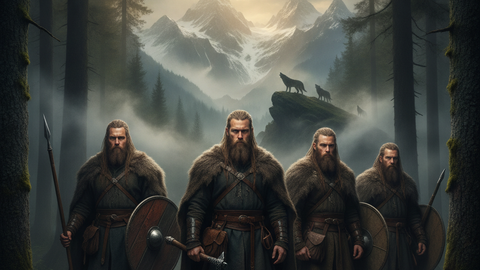
Here you will meet eight major Viking characters, understand the mystical place of the wolf in their culture, and discover a caste forgotten by most modern stories: the ulfhednar, these warriors in wolf skin who fought in the name of the Father of All Things.
The essential things to remember
- The Viking Age extends from 793 (Lindisfarne raid) to 1066 (death of Harald Hardrada).
- Eight characters dominate the sagas: Ragnar, Bjorn, Ivar, Lagertha, Freydis, Erik the Red, Rollo, Harald.
- Five sacred wolves populate Nordic mythology: Geri, Freki, Fenrir, Skoll, Hati.
- The ulfhednar fought wearing wolf skin, distinct from the berserkers wearing bear skin.
- Jewelry, pendants and clothing inspired by the Viking wolf extend this millennial heritage on a daily basis.
Who were the famous Viking characters?
The term "Viking" refers less to a people than to an activity: that of the Scandinavian sailor-warriors who, from the 8th to the 11th century, plundered, traded, explored and colonized a vast part of Europe and the North Atlantic. Three main kingdoms saw them born:
- Norway: fjords and raid leaders facing the Atlantic (Iceland, Greenland, America).
- Denmark: continued military pressure towards England and France.
- Sweden: trade routes to the Volga and Byzantium, lands of the Rus' Vikings.
Three categories of sources then make it possible to classify the Viking characters:
- Attested historical sources: Anglo-Saxon, Frankish and Arab chronicles.
- Icelandic sagas: semi-legendary stories compiled in the 12th and 13th centuries.
- Modern fiction: Vikings series, video games, contemporary novels.
Most of the big names below exist somewhere between history and myth, which is precisely their strength.
Summary table: 8 Viking characters to know
| Character | Period | Origin | Highlight |
|---|---|---|---|
| Ragnar Lothbrok | 750-865 (?) | Denmark / Sweden | Father of a dynasty, raids on Paris and Northumbria |
| Bjorn Côte-de-Fer | 9th century | Sweden | Raid in the Mediterranean (859-861) with 62 longships |
| Ivar the Boneless | died around 873 | Denmark | Conquest of York in 866, Great Pagan Army |
| Lagertha | 9th century | Norway | Skjaldmö, first wife of Ragnar |
| Freydis Eiriksdottir | around the year 1000 | Iceland / Greenland | Expeditions to Vinland (North America) |
| Erik the Red | 950-1003 | Norway / Iceland | Founding of Greenland in 985 |
| Rollo / Rollon | 860-930 | Norway or Denmark | First Duke of Normandy (Treaty of 911) |
| Harald of Fair Hair | 850-933 | Norway | First king of unified Norway (872) |
A question is rarely addressed in mainstream works: why does the wolf occupy such a central place in this universe?
Why the wolf occupies a sacred place in Viking culture
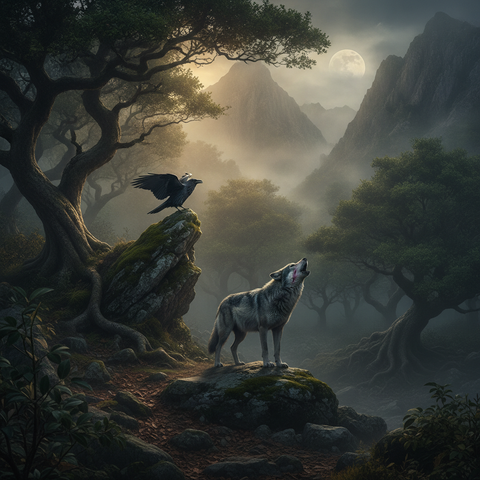
In Nordic mythology, the wolf is not a simple predator: it is a cosmic being. The god Odin, master of Valhalla, is constantly accompanied by two wolves, Geri and Freki, who receive all the food placed in front of him. The supreme god is content to drink mead, leaving his wolves to feast. This detail says everything about the respect that the Vikings had for this animal.
The 5 major wolves of Norse mythology
| Wolf | Meaning of the name | Role | Symbolic |
|---|---|---|---|
| Geri | "the glutton" | Wolf of Odin, hunting companion | Fidelity, sacred bond |
| Freki | "the greedy" | Second wolf of Odin, shares the feast | Controlled voracity, power |
| Fenrir | "the swamp dweller" | Son of Loki, chained by the gods | Destructive force, end of the world |
| Skoll | "the one who mocks" | Chases the sun in the sky | Solar cycle, celestial race |
| Hati | "he who hates" | Chases the moon in the sky | Lunar cycle, closure of time |
These stories, recorded in the 13th century by the Icelandic scholar Snorri Sturluson in the Prose Edda, show that the wolf embodies both fidelity, destructive power and the cosmic cycle.
This veneration is found in several archaeological objects:
- Wolf head pendants found in Birka, Sweden.
- Tattoos described by the Arab chronicler Ibn Fadlan in 921.
- Discoidal brooches engraved with lupine motifs, found in female tombs.
- Silver and bronze Amulets worn under clothing as ritual protection.
For a Viking character, carrying the wolf on one's person meant invoking the protection of Odin before each crossing and each fight. Even today, the collections Tatouages Loup and Pendentifs Loup continue this age-old tradition.
Ragnar Lothbrok, semi-legendary king and father of a dynasty
Express sheet
- Period: 750-865 (semi-legendary).
- Origin: Sweden and Denmark.
- Sources: Frankish chronicles, Saga of Ragnar Lodbrok.
- Highlight: raid on Paris in 845, death in a snake pit.
Ragnar Lothbrok is, without a doubt, the most famous Viking character in the world. A semi-legendary king of Sweden and Denmark, he appears in Frankish chronicles and in the Saga of Ragnar Lodbrok, where his exploits are mixed with clearly mythical elements, such as his death being thrown into a snake pit by King Aelle of Northumbria.
What makes Ragnar fascinating is less his personal exploits than the dynasty he created. His sons led the famous Great Pagan Army which swept across England in 865 to avenge their father:
- Bjorn Côte-de-Fer: conqueror of the Mediterranean seas.
- Ivar the Boneless: terrifying strategist, conqueror of York.
- Sigurd Serpent's Eye: king of Denmark.
- Hvitserk: raid leader in eastern England.
- Ubba: killed in battle against the Saxons in 878.
This military expedition, attested by the Anglo-Saxon Chronicle, lasted more than fourteen years and redrew the map of medieval England. The History Channel series Vikings popularized a fictionalized version of Ragnar, played by Travis Fimmel. For those who want to display this heritage, the Bijoux-loup”>Bijoux Loup offer pieces inspired by Nordic warrior symbolism.
Bjorn Côte-de-Fer, conqueror of the Mediterranean seas
Express sheet
- Period: 9th century, major raid between 859 and 861.
- Origin: Sweden, presumed eldest son of Ragnar.
- Sources: Arabic chronicles of Al-Bakri, Annales de Saint-Bertin.
- Highlight: expedition of 62 longships in the Mediterranean.
Reputed eldest son of Ragnar Lothbrok, Bjorn Ironside (Björn Járnsíða in Old Norse) led one of the most daring raids of the Viking Age. His itinerary remained engraved in the memory of chroniclers:
- Garonne back to the Aquitaine lands.
- Algeciras taken and pillaged.
- Strait of Gibraltar crossed for the first time by a Nordic fleet.
- Coasts of Morocco, Muslim Spain, Italy, Provence ravaged in turn.
- Luna in Tuscany taken by mistake, the attacker having thought he was targeting Rome itself.
This campaign is documented both by the Arabic chronicles of Al-Bakri and by the Annals of Saint-Bertin, which is rare for the time and gives Bjorn a more solid historicity than that of his father. His nickname “Côte-de-Fer” comes, according to the saga, from a protective amulet which made him invulnerable to injury. Back in Scandinavia, he reigned over Sweden and founded the Munsö dynasty, which produced several Swedish kings until the 11th century.
Ivar the Boneless, feared strategist
Express sheet
- Period: died around 873, probably in Dublin.
- Origin: son of Ragnar Lothbrok.
- Particularity: probable physical infirmity (osteogenesis imperfecta).
- Highlight: capture of York in November 866, founding of the kingdom of Jórvík.
Ivar Ragnarsson, nicknamed "the Boneless" (Inn Beinlausi), is undoubtedly the most terrifying of Viking characters. Suffering from a probable physical infirmity ("brittle bone disease"), he compensated with exceptional tactical intelligence and legendary cruelty towards his enemies. The sagas describe him carried as a shield by his warriors, unable to walk but unleashing brilliant military tactics.
It was he who commanded the Great Pagan Army when it took York in November 866, thus founding the Viking kingdom of Jórvík which would survive for almost a century. According to the Saga of the Sons of Ragnar, he made King Aelle of Northumbria undergo the sacrificial ritual of the blood eagle. Historians still debate the reality of this torture today, with some seeing it as a misinterpreted poetic metaphor.
His presumed grave was rediscovered in the 17th century and then scientifically excavated in Repton, England, starting in the 1970s by Martin and Birthe Biddle.
Lagertha, the skjaldmö with the courage of a man
Express sheet
- Period: 9th century.
- Origin: Norway.
- Status: skjaldmö (shield woman), queen of Norway.
- Sources: Gesta Danorum by Saxo Grammaticus (12th century).
Lagertha is the most famous of the skjaldmö, these "shield women" who fought alongside men. Its main source is the work of Saxo Grammaticus, a Danish chronicler of the 12th century, who describes it as follows:
"An astonishing woman, who, although tender by nature, showed the courage of a man and fought at the front among the most valiant, her hair flowing in the wind."
According to Saxo, she saved Ragnar Lothbrok during a decisive battle against the Swedish king Frö, turning the outcome of the fight through her bravery. Ragnar, seduced, would have married her before later repudiating her for Aslaug. Lagertha would then have reigned in her own name over part of Norway, and would have returned to lend a hand to Ragnar during a Danish civil war.
Modern historians debate whether it actually existed. Two theses oppose each other:
- Mythological thesis: figure inspired by the goddess Thorgerd Holgabrud.
- Historical thesis: tomb Bj.581 of Birka, identified in 2017 by DNA analysis as that of a warrior woman, proves that the skjaldmö did indeed exist.
To embody this proud, feminine heritage, the Loup Rings collection offers engraved rings reminiscent of the Scandinavian motifs worn by these warriors.
Freydis Eiriksdottir, the Vinland Explorer
Express sheet
- Period: around the year 1000.
- Origin: Iceland then Greenland, daughter of Erik the Red.
- Sources: Saga of the Greenlanders, Saga of Erik the Red.
- Highlight: expedition to Vinland (Newfoundland).
Natural daughter of Erik the Red and half-sister of Leif Erikson, Freydis Eiriksdottir is one of the rare Viking women to have led her own transatlantic expedition. The Icelandic sagas depict her as an ambiguous figure: courageous and terrifying.
The most famous episode took place around the year 1000 in Vinland, on the present-day coasts of Canada. The archaeological site of Anse aux Meadows confirmed in 1960 the Viking presence in America. Attacked by natives that the sagas call Skraelings, the vikings are about to flee when Freydis, pregnant:
- Draw a fallen sword.
- Bares her chest.
- Strikes the blade against it while screaming a war cry.
- Puts the terrified Skraelings to flight.
Another saga, however, presents her as manipulative and cruel, having had her associates assassinated during another expedition. Contemporary historiography sees in this duality a Christian influence from the Icelandic compilers, who sought to condemn paganism while recognizing the strength of its female figures.
Erik the Red and Leif Erikson, the pioneers of the Atlantic
Father and son express card
- Erik the Red: born around 950, banished from Iceland around 982, founded Greenland in 985.
- Leif Erikson: born around 970, first European to set foot on American soil around the year 1000.
- Key source: site of Anse aux Meadows (Newfoundland), excavated from 1960.
Erik Thorvaldsson, nicknamed "the Red" because of his flamboyant hair, was banished from Iceland for homicide around 982. Taking advantage of his exile, he explored a land seen earlier by other sailors and founded two colonies in Greenland in 985 (a name chosen deliberately to attract settlers, when the land had nothing green). These colonies survived for almost 500 years before mysteriously disappearing in the 15th century, probably due to the Little Ice Age.
His son Leif Erikson made history as the first European to set foot on American soil, almost 500 years before Christopher Columbus. Around the year 1000, he successively reached three lands which he named:
- Helluland: Baffin Land.
- Markland: Labrador.
- Vinland: Newfoundland, where the Anse aux Meadows site confirms its presence by carbon-14 dating.
The United States officially celebrates Leif Erikson Day every October 9, a day of recognition of the first European explorer of the New World. A statue of Leif has stood in Reykjavik since 1932, donated by the American government on the occasion of the millennium of the Icelandic Althing.
Rollo / Rollo, from the Viking chief to the Duke of Normandy
Express sheet
- Period: around 860-930.
- Origin: Norway (Snorri Sturluson) or Denmark (Dudon de Saint-Quentin).
- Highlight: Treaty of Saint-Clair-sur-Epte in 911, first Duke of Normandy.
- Posterity: direct ancestor of William the Conqueror in the 6th generation.
Rollo, Frenchified as Rollo, is the only Viking character on this list to have founded a lasting European principality. From 880 he led raids along the Seine, besieging Paris in 885-886 and ravaging Neustria.
Rather than continuing to suffer these invasions, King Charles III the Simple granted him in 911 a vast territory between Epte and the sea. In exchange, Rollo accepted several commitments:
- Converted to Christianity under the name Robert.
- Pay homage to the King of Francia.
- Defend the Seine against the other Viking fleets.
- Receive the title of duke, founding the Duchy of Normandy.
The story goes that Rollo, a proud Viking, refused to kiss the king's foot during the tribute ceremony. He charged one of his warriors to do it in his place, who raised the royal foot so high that the king fell backwards, to the laughter of the Nordics. True anecdote or not, it says a lot about the spirit of the Viking leaders who agreed to bend without ever submitting.
Harald Fair Hair, first king of Norway
Express sheet
- Period: 850-933.
- Origin: Norway.
- Highlight: unification of Norway after the Battle of Hafrsfjord (872).
- Main source: Heimskringla by Snorri Sturluson (around 1230).
Harald Hárfagri ("with the beautiful hair") went down in history as the unifier of the Norwegian kingdom. The Heimskringla saga relates that he vowed not to comb his hair again until he had conquered all of Norway. Vow fulfilled in 872 during the naval battle of Hafrsfjord, where he defeated the coalition of rebel jarls.
Under his reign, many Nordics refusing to submit to his authority emigrated to:
- Iceland: a population which will produce the most beautiful literary sagas.
- Scotland and the Hebrides: lasting Viking settlement.
- The Faroe Islands: new maritime bases in the North Atlantic.
The skaldic poem Haraldskvæði, composed around 900 by the poet Þórbjörn Hornklofi to celebrate Harald, is also the text which explicitly mentions the ulfhednar, these wolf-skinned warriors who fought for the king.
The ulfhednar, warriors in wolf skin
This is probably the most unknown aspect of Viking warrior culture. The ulfhednar (in Old Norse ulfheðnar, literally "those with wolf skin") formed a caste of elite warriors, distinct from the better known berserkers (the "bearshirts").
The skaldic poem Haraldskvæði describes them fighting:
"They howl, they bite their shields, they are furious like wolves."
Ulfhednar vs Berserkers: the comparison
| Criterion | Ulfhednar | Berserkers |
|---|---|---|
| Animal totem | Wolf | Bear |
| Literal name | "Wolf skin" | "Bear Shirt" (ber-serkr) |
| Tutelary God | Odin, via Geri and Freki | Odin, brute force |
| Combat Outfit | Complete wolf skin, muzzle turned down | Bearskin or shirtless |
| Behavior | Howls, shield bites, pack trickery | Destructive fury, frontal charge |
| Modified state | Ritual trance, possibly amanita | Berserksgangr, Holy Fury |
| Key written source | Haraldskvæði (around 900) | Ynglinga saga, Egils saga |
| Reputation | Wild Strategists, Pack Fight | Lone Demon Fighters |
According to the sagas, the ulfhednar:
- Were wearing a complete wolf skin, muzzle pulled down to the face.
- Were insensitive to pain in the middle of combat.
- Were said to be immune to injury by fire and iron.
- Entered second states which terrified their adversaries.
- Fought in coordinated pack, like Odin's wolves.
Archaeological excavations at Birka, Sweden, carried out between 1872 and 1895, uncovered silver pendants in the shape of a wolf's head that contemporary historians associate with this brotherhood of warriors. For those who want to extend this imagination at home, the Wolf Jackets and Blousons collections take up the codes of the Nordic warrior, while the Wolf Decorations allow you to transform an interior in homage to the cult of Odin and his wolves.
Viking and wolf symbols: what these characters wore
Viking characters did not dress randomly: each piece worn had a ritual, magical or social meaning. The Arab chronicler Ibn Fadlan, who met Rus' vikings in 921 on the banks of the Volga, described their tattoos at length:
"They are tattooed from the tips of the fingers to the neck, with colored trees, figures, etc."
Major symbolic objects
| Object | Material | Symbolic | Current collection |
|---|---|---|---|
| Wolf head pendant | Silver or bronze | Protection of Odin, link to Geri and Freki | Wolf pendants |
| Discoidal spindle | Bronze | Social status, intertwined wolf-snake patterns | Wolf Accessories |
| Engraved ring | Silver, bronze | Oath, lineage, rank of skjaldmö | Wolf rings |
| Studded belt | Leather and bronze | Warrior status, carrying the sword | Wolf Belts |
| Tattoos | Natural pigment | Identity, wolves, snakes, interlacing | Wolf Tattoos |
Today, these codes are found in inspired jewelry and accessories: the Wolf Pendants collection extends the spirit of the Birka amulets, the Wolf Belts recall the studded leather belts of warriors, and the Wolf Accessories brings together brooches, badges and keyrings engraved with Nordic symbols.
How to embody Viking heritage in your daily life
To extend the power of the ulfhednar and the wisdom of Odin, here is an actionable checklist inspired by authentic Norse codes.
To do
- Wear a wolf head pendant in the spirit of Birka amulets, under clothing for discreet protection.
- Choose intertwined patterns: Nordic knots, Algiz and Tiwaz runes.
- Choose an engraved ring in the tradition of skjaldmö rings, such as those from the Loup Rings collection.
- Test a wolf hooded garment reminiscent of the turned down snout of the ulfhednar, without falling into crude cosplay.
- Read the primary sources: Snorri Sturluson, Saxo Grammaticus, Ibn Fadlan.
To avoid
- The horned helmets: theatrical invention of the 19th century, historically false.
- The approximate replicas of the television series, disconnected from archaeology.
- The caricatural folklore which erases the depth of the Nordic myth.
- The Wikipedia summaries as the only source, which flatten the richness of the sagas.
This approach avoids the pitfall of caricatured folklore and truly honors the spirit of the great Viking characters.
The legacy of Viking heroes in modern culture
More than a thousand years after their last raids, Viking characters have never been more present in popular culture:
- TV series: Vikings (2013-2020) on History Channel, Vikings: Valhalla on Netflix.
- Video games: Assassin's Creed Valhalla (2020), God of War Ragnarök (2022), Hellblade.
- Novels and comics: massive resumption of the themes ulfhednar, skjaldmö and Ragnarök.
- Music: Nordic metal, Scandinavian neofolk, original soundtracks inspired by the sagas.
This resurgence is not just a fictional phenomenon. Enthusiasts turn to jewelry and accessories inspired by the Nordic world to carry with them the symbols that gave strength to these warriors and explorers. The wolf amulets, the rings engraved with runes, the pendants with the head of Fenrir extend a twelve-century-old imagination.
If the spirit of the Viking wolf speaks to you, the entire Bijoux Loup collection offers pieces that honor this tradition. And if you are looking to embody these characters during an event, the disguises and accessories in the store allow an immersion faithful to the warrior aesthetic of the ulfhednar and the skjaldmö.
Viking Characters Frequently Asked Questions
Who is the most famous viking character in history?
Ragnar Lothbrok comes first thanks to the Vikings series, but on a strictly historical level, it is probably Harald Fairhair (first king of Norway) or Rollo (founder of Normandy) who have had the most lasting political impact. Leif Erikson holds the title of first European to have set foot on American soil.
Who is the most feared viking?
Ivar the Boneless, for his legendary cruelty towards his enemies and his leadership of the Great Pagan Army in 865. Several Anglo-Saxon chronicles present him as the most terrifying figure of the Viking invasion of England.
Did Lagertha really exist?
Historians are still debating. The main source is Saxo Grammaticus in the 12th century, therefore well after the supposed facts. However, excavations of tomb Bj.581 in Birka, identified in 2017 by DNA as that of a female warrior, prove that the skjaldmö did indeed exist.
What does the wolf symbolize among the Vikings?
Strength, loyalty, sagacity, but also cosmic chaos depending on the wolf considered. Geri and Freki embody loyalty to Odin; Fenrir represents the end of the world; Skoll and Hati personify the cyclical course of the stars.
Who are the ulfhednar?
A caste of elite Viking warriors who fought dressed in wolf skin, in ritual trance, under the protection of Odin. Distinct from berserkers (bear skin), they are attested in the skaldic poem Haraldskvæði dated around 900 and confirmed by the wolf head pendants found at Birka.