
Athelstan Vikings, the monk who became Ragnar's Nordic soul
of reading - words
Few characters from the Vikings series fascinate as much as Athelstan. Anglo-Saxon monk captured during the founding raid of Lindisfarne in 793, slave then close friend of Ragnar Lothbrok, spiritual guide of a dynasty of Northern warriors: this priest tattooed with runes embodies the bridge between two enemy worlds. His silhouette, brown under the hood and cross on the neck, crosses 30 episodes over 4 seasons like a soft shadow in the Nordic pack. However, it never existed historically: it bears the name of a very real English king, Athelstan of England (927-939), and that's it. This journey between television fiction, medieval archives and the symbolism of the Nordic wolf will clarify the request athelstan vikings series that women passionate about mythology ask each month on the engine.
The essential things to remember
- Athelstan is a fictional character created by Michael Hirst for the series Vikings (2013-2020).
- He is captured during the raid of Lindisfarne in 793 in the first episode of season 1.
- He becomes the friend, scribe and spiritual guide of Ragnar Lothbrok.
- He dies murdered by Floki in season 3 (episode “Born Again”, 2015).
- The English king Athelstan (894-939) is a distinct real-life figure, the first ruler to unify England.
Athelstan, the monk who became a companion of the Vikings
Athelstan is a fictional Anglo-Saxon monk from the Vikings series, captured by Ragnar Lothbrok and become his close friend.
The name Athelstan comes from the Old English AEthelstan, which literally means "noble stone". This name runs through Anglo-Saxon history like a wire: it belongs as much to a fictional monk as to a real king, which has confused the query since the arrival of the series Vikings on the screens in 2013.
In the fiction of Michael Hirst, Athelstan is presented as a young monk from the monastery of Lindisfarne, polyglot, scribe, fascinated by foreign languages. His knowledge of Old Norse is what saves his life: Ragnar Lothbrok, seeing him in the middle of the carnage of the plunder, decides to spare him to use him as a translator. The character is played by actor George Blagden over 30 episodes spread between season 1 (2013) and season 4 (2016).
The request athelstan vikings series returns with a solid monthly volume, a sign that the character continues to fascinate even five years after the end of the broadcast. His trajectory is unique in the series: he is the only non-Viking character to accompany Ragnar on his spiritual quest, and his body tattooed with Nordic runes will rub shoulders with the Christian cross until his last breath.
Capture in Lindisfarne, birth of the character
Athelstan appears in fiction at the heart of the Viking raid of Lindisfarne in 793, the first cultural clash between the North and England.
The Lindisfarne Raid in 793 is a major historical event, considered by most historians to be the true beginning of the Viking Age in Western Europe. This island monastery on the northeast coast of England, founded in the 7th century, was home to a community of Benedictine monks renowned for its library, relics and sacred jewelry.
Michael Hirst uses this historical fact as a setting to open his series. The sequence of the pillaging of Lindisfarne, presented in the episode "The Expedition" (season 1, 2013), depicts the discovery of the Anglo-Saxon world by Vikings who had not yet crossed the North Sea. Athelstan appears in this chaos, a bloody brown robe, handing a liturgical book to Ragnar in a gesture of submission.
Why does Ragnar spare him, while all the other monks are massacred or kidnapped as ordinary slaves? The series gives three clear reasons:
- Athelstan speaks Old Norse, which makes him immediately useful as a translator for future raids.
- He is literate, capable of copying texts, understanding calendars and charters.
- His intellectual curiosity intrigues Ragnar, who likes to surround his table with atypical characters, sort of brothers in thought.
The Lindisfarne Raid does exist in the annals, but the character of Athelstan is entirely a Michael Hirst creation. No Anglo-Saxon chronicle, no Icelandic saga, mentions a surviving monk taken away by the plunderers and integrated into their family. The screenwriter brought together in this character the traits of several real cultural mediators who we find later, notably Ansgar, a Frankish missionary from the 9th century who partially evangelized the Nordic world.
The evolution of Athelstan, slave, friend, spiritual guide
Athelstan goes through four seasons, going from terrified slave to Ragnar Lothbrok's intimate spiritual guide.
Athelstan's story arc in Vikings is one of the richest in the series. In four seasons, the monk goes from being a terrified slave to becoming an adopted member of Ragnar's family. His transformation takes place step by step, never linear, always torn between his original faith and his fascination with the Nordic world.
| Season | Year | Key event | Athelstan Status |
|---|---|---|---|
| Season 1 | 2013 | Capture at Lindisfarne, integration at Ragnar | Slave turned servant letter |
| Season 2 | 2014 | Escaped crucifixion, journey with Ragnar to Wessex | Official translator, family friend |
| Season 2 (end) | 2014 | Partial conversion to Norse paganism | Syncretist priest, runic tattoo |
| Season 3 | 2015 | Return of the Christian faith to Paris | Tormented pilgrim, close friend of Ragnar |
| Season 3 | 2015 | Death by Floki in his bed | Martyr of syncretism, mourning of Ragnar |
Upon his arrival, Athelstan first serves Ragnar's house with Lagertha (see our article on Lagertha Viking), shares meals, learns to hunt, watches the children grow up. Bjorn, the eldest son, gradually considers him as an uncle. The series shows very well the slow erosion of hierarchical distance: we move from order to dialogue, from respectful silence to intimate confidence.
When Ragnar becomes earl and then king, it is Athelstan whom he first consults on questions of strategy, trade and even theology. This emotional dependence of a Viking leader on a former Christian monk is a strong singularity of Michael Hirst's work, and it is also what will ultimately cost the character his life.
Christian faith, Nordic paganism, the syncretism of Athelstan
Athelstan embodies a unique religious syncretism, torn between his Roman Christian faith and the Norse pantheon of Odin.
Athelstan's real subject in Vikings is not war or power: it is religious syncretism. The monk of Lindisfarne, raised in the Roman liturgy, suddenly discovers a pantheon where Odin, Thor, Frigg, Tyr, Loki, Freyja, Freyr, as well as the cosmic wolf Fenrir and his celestial brothers coexist. This theological confrontation silently eats away at him.
Five signs of this spiritual syncretism return in the series:
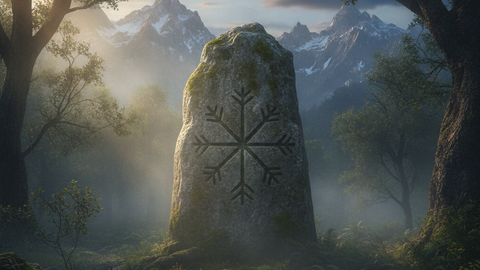
- The acceptance of a runic tattoo on the body, in a founding scene of season 2.
- Participation in the Nordic rituals of Uppsala, where the Vikings sacrifice men and animals to Odin.
- The preservation of the rosary and the cross under one's tunic, even after these rituals.
- The mystical visions where Christ and Nordic figures mingle, shown through flashbacks.
- The permanent doubt verbalizes in his conversations with Ragnar: "Which god lives in my body?"
This theme of the ferryman between two spiritual worlds is not a pure invention. Several real historical figures navigated between Christianity and Norse paganism in the 9th century. Ansgar, archbishop of Hamburg-Bremen, was sent as a missionary to Sweden and Denmark around 829, and his successor Rimbert documented these exchanges in the Vita Anskarii. On the material level, the Gosforth cross (10th century, Cumbria) is the archetype of these sacred objects where crucified Christ and figures of Ragnarok coexist in the same stone.
For women who recognize themselves in this quest for spiritual identity, the Loup Rings TDL collection extends the gesture: the ring is worn on the finger as a silent sign of belonging to a hybrid world.
The death of Athelstan, Floki's gesture
Athelstan is murdered by Floki in the episode Born Again from season 3, in 2015, while he is praying.
Warning: this paragraph reveals the end of the character in season 3.
The death of Athelstan is one of the most poignant moments in the entire Vikings series. It occurs in episode 6 of season 3, entitled "Born Again" (2015). Floki, the fanatical boat builder and fierce defender of the Norse gods, can no longer stand thepresence of a Christian alongside Ragnar. He sees in Athelstan a spiritual corruption that turns his king away from the old gods and threatens the cohesion of the clan.
Floki enters Athelstan's house in broad daylight, an ax in his hand. The monk, praying silently in the light of the room, looks up, smiles gently, and accepts the blow without resistance. His last words are a blessing, not a curse. The scene closes with blood flowing onto the light wooden floor, then Ragnar's face discovering the body.
The Viking chief then himself carries Athelstan's remains to the top of an isolated hill, in the long sequence which ends the episode. This gesture, without words, prepares the break between Ragnar and Floki, which will be the narrative driving force of the following two seasons and will end up condemning the boat builder to long torture. Athelstan's death acts like a silent earthquake: it releases Ragnar's grief and hardens his soul until the end.
Athelstan monk or king: the double identity to be clarified
Two Athelstans exist: a fictional monk from the Vikings series and a real English king who reigned from 927 to 939.
The query athelstan monk or king comes up massively on Google, a sign of frequent confusion. Two Athelstans exist: the fictional monk you have just discovered, and a very real English king who lived three centuries later. The following table clearly distinguishes them.
| Criterion | Athelstan monk (Vikings series) | Athelstan king (true story) |
|---|---|---|
| Existence | Fictional, creation by Michael Hirst | Real, attested by the Anglo-Saxon Chronicles |
| Dates | Capture at Lindisfarne in 793 (fictitious timeline) | 894 - 939 AD |
| Origin | Anglo-Saxon monk, monastery of Lindisfarne | Son of Edward the Elder, dynasty of Wessex |
| Role | Slave then friend and spiritual guide of Ragnar | First king to unify England (927-939) |
| Report to the Vikings | Capture, religious syncretism, partial conversion | Winner of the Vikings at the battle of Brunanburh (937) |
| End | Killed by Floki in season 3 (2015) | Died of natural causes at age 45 |
No direct historical link connects the fictional monk to the real king. Michael Hirst simply borrowed a common Anglo-Saxon first name that rang true to modern audiences. The historical king is a major figure in British history: grandson of Alfred the Great, he defeated the Vikings, the Scots and the Welsh gathered at Brunanburh in 937, sealing for the first time the unity of an English kingdom. His court became a center of culture, goldsmithing and European diplomacy, with close ties to the Frankish and Germanic kingdoms.
Athelstan and the Norse Wolf Totem
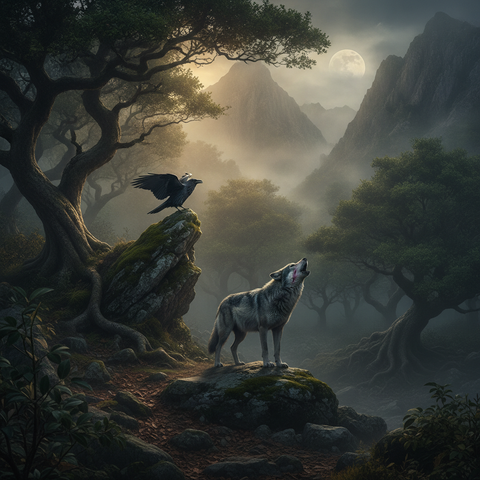
Athelstan discovers a Nordic cosmology where the wolf occupies a sacred place, from Odin's brothers to Fenrir the devourer of worlds.
By integrating into Ragnar's family, Athelstan discovers a cosmology where the wolf occupies a central place, much higher than that of the Christian symbol of the lamb. The Norse pantheon has several major wolves, each carrying a different force, and the monk of Lindisfarne is deeply imprinted by them, as evidenced by his visions and his language in seasons 2 and 3.
- Geri and Freki, the two faithful wolves of Odin, share the table of the supreme god and symbolize absolute warrior loyalty.
- Fenrir, son of Loki, is the cosmic wolf chained by the gods and destined to tear the world apart at Ragnarok.
- Skoll and Hati are the two celestial wolves who eternally pursue the sun and the moon in their course.
- The wolf specifically embodies maternal protection and pack cohesion, a powerful archetype for Nordic women.
- The white wolf is associated with shamanic clairvoyance in certain Saami traditions of the Far North.
For those who feel this resonance between Athelstan's spiritual quest and the wolf totem, Terre des Loups offers several concrete ways to wear this symbol on a daily basis. Here is how to ritualize this passage:
- Choose a Wolf Pendant to wear silently under your shirt, as Athelstan wore his cross: see the Wolf Pendants collection.
- Tie a braided or metal Wolf Bracelet, which evokes the chains of Fenrir: discover the Wolf Bracelets collection.
- Put on a warm and wide Loup Sweatshirt, perfect for the Nordic winter: explore the Loup Sweatshirts collection.
- Bring together several Bijoux Loup to ritualize the passage between two worlds: the Bijoux Loup collection brings together rings, necklaces, earrings.
- Keep a discreet sign on yourself every day, like a runic tattoo invisible to others.
These pieces are not simple accessories. They function like silent runes, markers of belonging to a universe where nature, instinct and fidelity are worth more than hierarchy. The gesture of Athelstan, who accepted the runic tattoo without denying his cross, can be reproduced today in the simple decision to wear a wolf on his finger or on his neck.
Athelstan's cultural legacy in pop culture
Athelstan remains one of the cult characters of the Vikings series, carried by the masterful interpretation of actor George Blagden.
Athelstan's popularity in pop culture goes far beyond the simple Vikings series. George Blagden, a British actor trained in the theater, delivers a remarkably fragile performance, which transforms a secondary character on paper into the emotional pivot of the saga. His soft voice, his constantly questioning gaze, his slim body among the Scandinavian colossi: everything contributes to making him an unforgettable figure.
Five years after the end of broadcast, the character continues to live. Forums dedicated to Norse mythology often cite Athelstan as an example of a "transmitter" between cultures, and many fans have had runic tattoos inspired by those he wears on his body. His death is still the subject of heated discussion, and some consider it the true end of the "first era" of the series, the one that ended with Ragnar.
If you wish to extend this journey among the emblematic figures of Vikings, several other profiles complete that of Athelstan: the warrior Lagertha Viking, the pack leader Ragnar Lothbrok, or the complete gallery of Viking characters covered on the blog. The mythology that surrounds them is also that which irrigates Athelstan's visions: a wild, mystical world, where the gods still walk alongside men.
Frequently asked questions about Athelstan
This FAQ brings together the five most asked questions about Athelstan, from the fictional monk to the historic English king.
Did Athelstan really exist?The monk Athelstan from the Vikings series is an entirely fictional character, created by Michael Hirst. No Anglo-Saxon chronicle or Icelandic saga mentions a surviving monk from the Lindisfarne raid who was part of the family of a Viking chief. On the other hand, the English king Athelstan (894-939) is a real historical figure, the first ruler to unify England.
How does Athelstan die in Vikings?Athelstan is murdered by Floki in episode 6 of season 3, entitled "Born Again" and broadcast in 2015. Floki enters his house with an ax in his hand and kills him while he is praying. Ragnar Lothbrok then carries the remains to the top of a secluded hill, a gesture that will trigger his gradual breakup with Floki.
What is the connection between Athelstan and the King of England?No direct historical link. Michael Hirst simply borrowed a common Anglo-Saxon first name. King Athelstan ruled England from 927 to 939, more than a hundred years after the Lindisfarne Raid of 793. He is known for having defeated a coalition of Vikings, Scots and Welsh at the Battle of Brunanburh in 937.
Why does Ragnar spare Athelstan?Ragnar spares Athelstan for three reasons: his knowledge of Old Norse which makes him useful as a translator, his ability to read and copy texts, and his intellectual curiosity which intrigues the Viking leader. This atypical decision for a raid leader is what makes the character of Ragnar unique in the series.
Was Athelstan Christian or Viking?Athelstan remained a figure of religious syncretism until his death. Raised in the Roman Christian liturgy, he accepts a runic tattoo in season 2 and participates in Nordic rituals, while retaining his cross and his rosary. His visions mix Christ with figures from the Nordic pantheon. He never really chose a side, and it is precisely this double belonging that Floki can no longer stand.