
Lagertha the Viking: A Shield-Maiden's Story and Legend
of reading - words
More than a thousand years on, Lagertha's name still lands with the weight of a battle cry. Ragnar Lothbrok's first wife, a round-shield warrior, and a queen of Norway by legend, she has loomed over the Norse imagination for nearly 1,200 years. Yet only one ancient source ever names her, which leaves her existence as much a mystery as a story. In this piece, you will meet the real Lagertha: the shield-maiden, the queen, the she-wolf. For many women drawn to Norse mythology today, she has become a kind of mirror for their own strength.
Key takeaways
- Lagertha is named only by Saxo Grammaticus in the Gesta Danorum (around 1200).
- He paints her as a shield-maiden, the first wife of Ragnar Lothbrok, and a queen of Norway.
- The 2017 Birka dig confirmed that real Viking warrior women existed.
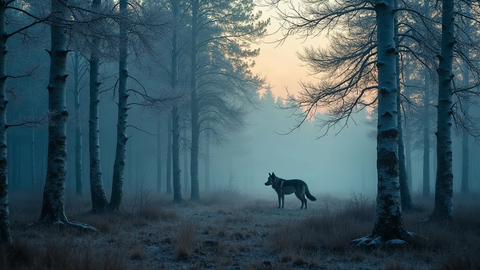
- In the Norse tradition, her totem animal is the she-wolf, a symbol of matriarchal strength.
- The Vikings TV series (2013-2020) turned her into a modern feminist icon.
Where Lagertha comes from: Saxo Grammaticus and the Gesta Danorum
Lagertha shows up in only one ancient source: the Gesta Danorum, a Latin chronicle written around the year 1200 by the Danish monk Saxo Grammaticus. In it, Saxo wove old Scandinavian oral traditions into a founding history of Denmark. Lagertha turns up in Book IX, slipped into the legend of Ragnar Lothbrok.
Her Old Norse name, Hladgerdr, is built from two telling roots: Hlad, a piece of head-dress or ornament, and gerdr, an enclosure that shelters. Protection, then, was sewn into her name from the very moment the legend was first told.
| Source | Date | Type | Historical reliability |
|---|---|---|---|
| Gesta Danorum (Saxo Grammaticus) | around 1200 | Latin chronicle | The only source, written about 300 years after the supposed Viking age |
| Icelandic sagas | 12th-13th century | Literary narratives | Do not mention Lagertha at all |
| Mythology of Thorgerd | Before 1200 | Oral tradition | A hypothesis: Lagertha may be an echo of this Norse goddess |
| Birka excavation (Bj 581) | 2017 | Archaeology and DNA | Confirms that real Viking warrior women existed |
| Carolingian chronicles | 9th century | Annals | No direct mention of Lagertha |
A number of modern historians, with Judith Jesch among them, argue that Saxo embellished or even invented this figure to round out Ragnar's epic. Others suspect a link with Thorgerd, a warrior goddess from Norse mythology. Lagertha never appears in any known Icelandic saga, which leaves her balanced on the line between myth and history.
The shield-maiden: archetype of the Viking warrior woman
Lagertha is the embodiment of the shield-maiden, those warrior women who fought side by side with men across the Norse world. The Old Norse word skjaldmo literally means "shield-maiden", and it names a woman who picks up a weapon by choice, for revenge, or out of duty.
The shield-maiden carries a recognisable set of traits, drawn from the sagas and the chronicles:
- Full battle kit: a round wooden shield rimmed in iron, a one-handed axe or a long sword, and a mail shirt.
- Tight war braids that kept her line of sight clear, sometimes finished with beads or bone.
- Respected social standing, on occasion equal to or above that of noble men.
- Possible economic independence, often through inheritance or widowhood.
- Spiritual life shaped by figures like the Valkyries or the goddess Freyja.
Search interest in lagertha shield maiden keeps climbing, and it tells us how many readers want to understand how a woman could truly live that warrior life. Lagertha is its best-known face, thanks to Saxo, who pictures her riding at the head of the lines with her hair loose in the wind.
Meeting Ragnar Lothbrok and the legendary battles
In the Gesta Danorum, Ragnar Lothbrok first sees Lagertha in Norway as she is fighting to avenge her people. The Scandinavian king is struck by her courage and asks for her hand. Lagertha is not a woman to be won easily, though, and she sets her own price.
From there, the legend follows a clear path:
- Ragnar lands in Norway to back a popular revolt against a local tyrant.
- Ragnar watches a battle in which Lagertha fights among newly freed women, her hair unbound.
- Won over by her bravery, Ragnar proposes; she lays down her own terms first.
- To claim her, Ragnar has to defeat a bear and a savage hound that she has stationed in front of her home.
- He survives, and they marry. Three children come of this union: Fridleif and two daughters.
The couple then fight side by side, notably against the Swedish king Frode. The marriage does not last, though. Ragnar puts her aside to marry Thora, daughter of the king of Gotland. Lagertha returns to Norway with her pride intact and her sword still hanging on the wall. She draws strength from the wound, the way a she-wolf feeds her cubs through winter. For those who want to carry that same fire every day, the Wolf pendants and Wolf bracelets from the TDL Norse collection keep the warrior symbol close.
Lagertha as queen and leader: feminine leadership in the Norse world
After her divorce, Lagertha marries a Norwegian nobleman and rises to a secondary throne, which makes her one of the rare female sovereigns recorded in medieval Scandinavian literature. For the period, that position was exceptional.
Years later, when Ragnar runs into an inner revolt in Denmark, he reaches out to his former wife. According to Saxo, Lagertha answers with a fleet of 120 ships, no small force. She fights on the front line, helps secure the victory, and then sails back to Norway. The story then takes a hard turn: Lagertha kills her new husband in his sleep and rules her territory on her own.
Brutal independence like that is rare in medieval texts. It marks Lagertha as a full warrior queen: self-governing, decisive, and free of any male guardian. The search interest behind lagertha queen reflects exactly that fantasy of feminine sovereignty that modern pop culture has grabbed with both hands.
Myth or reality: what Viking archaeology tells us
We still cannot prove that Lagertha herself lived. What archaeology has proven is that Viking warrior women did. The 2017 Birka dig in Sweden turned the standard reading of Viking burials upside down.
| Criterion | Traditional reading (before 2017) | Revised reading (after Birka) |
|---|---|---|
| The Bj 581 grave at Birka | A high-ranking male warrior | A female warrior, confirmed by DNA |
| Grave goods | Sword, axe, spears, arrows, 2 horses | Same kit, now attested as female |
| Strategy game found in the grave | Marker of a war chief | Confirms the role of a tactician |
| Existence of the shield-maidens | Literary and mythological only | Backed by physical evidence |
| Social rank of these warrior women | Marginal | Possible within the elite |
The DNA analysis published in the American Journal of Physical Anthropology in 2017 confirmed that the person in grave Bj 581 was genetically a woman, buried with the full arsenal of a war commander. That alone does not prove Lagertha existed as a real person, but it does back up the social role she stands for in the myth. Saxo Grammaticus was not making things up out of thin air: the Viking warrior woman was a real, if rare, possibility. Judith Jesch adds a note of caution: being a shield-maiden was not common, but a striking exception that left its mark on many generations of imagination.
Lagertha's totem animal: the she-wolf, matriarchal force
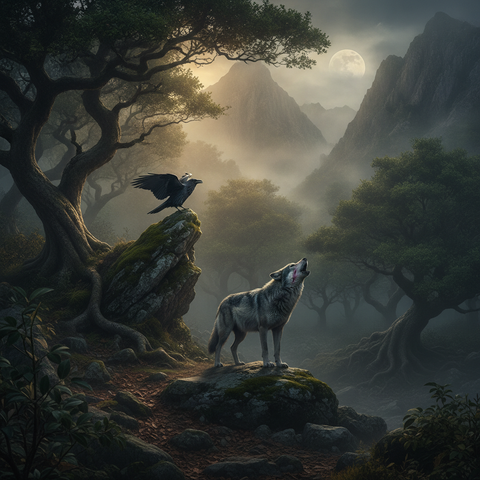
In the Norse tradition, the she-wolf stands for protective strength, the pack, and the fierce maternal instinct, which makes her the natural totem of Lagertha. The wolf sits at the centre of Viking cosmology, from Odin's two faithful companions, Geri and Freki, all the way to the cosmic wolf Fenrir, the one who will tear the world apart at Ragnarok.
How the she-wolf is read in the Norse pantheon:
- Geri and Freki, Odin's two wolves, stand for warrior loyalty and the fighter's hunger.
- Fenrir, son of Loki, embodies untamed strength and inescapable fate.
- Skoll and Hati, the two celestial wolves, chase the sun and the moon for eternity.
- The she-wolf in particular is tied to protective motherhood and to the bond that holds the pack together.
- The white wolf is linked, in some Sami traditions, to shamanic vision.
Lagertha brings these qualities together like a she-wolf at the head of her pack: she shields her own, fights ferociously, leads quietly, and stays loyal to the clan. Here is how to carry that totem in daily life and keep the Lagertha archetype alive:
- Choose a she-wolf pendant in aged silver, never in a flashy plating.
- Lean towards pack motifs (two wolves facing each other, a wolf's head with the moon) rather than lone howling wolves.
- Pair it with a Norse rune (Algiz for protection, Uruz for raw strength) to deepen the meaning.
- Steer clear of cheap alloy copies, which tarnish in a few weeks.
- Check the size of the pendant (2.5 to 4 cm is the sweet spot, visible without overpowering the neckline).
To live this totem beyond a single piece, the Wolf rings collection and the wider Wolf jewellery range from TDL carry the shield-maiden spirit into everyday wear. The Wolf sweatshirts give you a way to wear the she-wolf even when no jewellery is showing.
Lagertha's legacy: from the Vikings series to feminist icon
The Vikings series, aired from 2013 to 2020 on History Channel, lifted Lagertha to global feminist-icon status, largely on the strength of Katheryn Winnick's performance. The Canadian actress, a Chito-Ryu karate black belt, gave the warrior a physical credibility that stuck with viewers.
Three pillars hold up Lagertha's modern pull:
- Autonomy and leadership: she chooses, she commands, she rules with no one standing over her.
- Physical and moral courage: she takes up weapons, and she takes the unpopular calls.
- Fighting motherhood: she protects her children while she leads the war, refusing the easy split between power and tenderness.
Cosplay and tattoo communities have made her their own. The query lagertha tattoo is one of the most shared on Viking forums. To wear that legacy day to day, the Wolf T-shirts and the Wolf tattoos collection carry the shield-maiden's energy in more accessible codes. Beyond pop culture, Lagertha now stands for an archetype Jungian psychology would call the warrior-mother: a rare figure, more inward than mediatic, who speaks to women in search of their own sovereignty.
Frequently asked questions about Lagertha the Viking
Did Lagertha really exist?
There is no firm proof. Lagertha shows up only in the Gesta Danorum by Saxo Grammaticus (around 1200), a single source written more than three centuries after the supposed Viking age. Modern historians treat her as a semi-legendary figure, possibly inspired by real warrior women or by a mythological echo of the goddess Thorgerd.
Who was Lagertha to Ragnar Lothbrok?
Saxo Grammaticus describes Lagertha as the first wife of Ragnar Lothbrok, the legendary Danish king. Together they had a son named Fridleif and two daughters. The marriage ended in divorce when Ragnar set her aside to wed Thora. Even so, Lagertha kept hold of her power in Norway and fought beside her former husband during a later revolt.
Why is Lagertha not in the Norse sagas?
The classic Icelandic sagas (Heimskringla, the sagas of the Icelanders) never mention her. That silence reinforces the idea that she is either a literary creation of Saxo Grammaticus or a figure tied more firmly to Danish tradition than to the wider Norse world. The sagas tend to focus on founding male figures and on Icelandic genealogies.
Why is Lagertha a feminist symbol?
Lagertha brings together attributes that are rare in any medieval female figure: warfare, autonomy, royalty, vengeance, and motherhood. She makes her own choices about love, battle, and politics. The Vikings series amplified those traits and turned her into a contemporary icon of feminine sovereignty. Today her name moves through spiritual feminist circles and communities drawn to archetypal warrior-mother figures.
What is the totem animal of Lagertha the Viking?
In the Norse symbolic reading, the she-wolf is Lagertha's totem. She stands for matriarchal strength, the cohesion of the pack, fierce protection of her own, and territorial autonomy. The wolf is central to Viking mythology, from Odin's companions (Geri and Freki) to the cosmic wolf Fenrir. Wearing a she-wolf piece, like a pendant or a ring, is a grounded way to keep that totem alive in your daily life.