
Viking gods: Odin, Thor, Loki and the other masters of Asgard
of reading - words
The Viking gods form a dense pantheon, structured in two families and marked by powerful animal figures, foremost among them the wolves. Before introducing the 9 essential figures, keep one thing in mind: almost everything we know about the Norse pantheon comes from a single man, Snorri Sturluson, an Icelandic writer who composed his Prose Edda between 1220 and 1241. Without him, 80% of this corpus would be lost, and you would probably know nothing of Odin, Thor or Fenrir.
This article puts the pantheon back in order, sheds light on the divine wolves who run through it from end to end, and bridges the gap with the material symbols (Mjolnir, Gungnir, Brisingamen) you see on Viking jewellery and tattoos. Formal tone, wild voice, zero academic detour.
The essentials
The Viking pantheon boils down to 9 cardinal figures split into two divine families, threaded from end to end by five cosmic wolves that form the backbone of Norse mythology.
- The Viking gods divide into Aesir and Vanir, two divine families who waged war on each other before forming an alliance.
- Odin rules over Asgard, permanently accompanied by two wolves (Geri and Freki) and two ravens (Hugin and Munin).
- Thor is the most popular god among the Viking people, armed with his hammer Mjolnir.
- Loki is the father of Fenrir, the cosmic wolf who will devour Odin at Ragnarok.
- The divine wolves (Geri, Freki, Fenrir, Hati, Skoll) form a connecting thread through the pantheon, central to Norse mythology.
- The cult of the Norse gods quietly survived for several centuries after the official Christianisation of Iceland in 999-1000.
Who the Viking gods are: Aesir and Vanir in 2 minutes
The Viking gods split into two main families, the Aesir and the Vanir, dwelling in different worlds within the cosmic tree Yggdrasil.
The Aesir inhabit Asgard, a celestial realm connected to the humans of Midgard by the rainbow bridge Bifrost. These are the warrior and sovereign gods: Odin, Thor, Tyr, Heimdall, Baldr, Loki. The Vanir live in Vanaheim and embody fertility, prosperity and natural magic: Njord, Freyr, Freyja.
The two families first clashed, then made peace by exchanging hostages. Njord, Freyr and Freyja joined the Aesir at Asgard, which is why you generally find them listed together in modern overviews.
Here are the essential landmarks for placing the pantheon:
- Asgard: stronghold of the Aesir, residence of Odin.
- Midgard: world of humans.
- Vanaheim: world of the Vanir.
- Jotunheim: world of the giants, often enemies of the gods.
- Yggdrasil: the world tree that links the 9 realms together.
- Valhalla: Odin's great hall where warriors fallen in battle are welcomed.
Odin, the Allfather and the god with two wolves
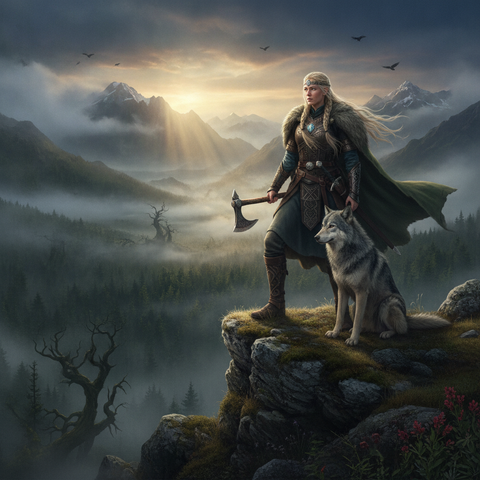
Odin is the sovereign of the Aesir, master of Asgard, and he is always flanked by two wolves, Geri and Freki, as well as by two ravens, Hugin and Munin.
His domains cover war, wisdom, poetry and runic magic. To gain the knowledge of the runes, he hung himself for nine days and nine nights from the tree Yggdrasil, pierced by his own spear. To drink the mead of Mimir, he sacrificed one of his eyes. This god is one-eyed, haunted, and obsessed with wisdom.
His attributes are recognisable at a glance on the wolf rings from TDL inspired by the Norse gods:
- Gungnir: his spear forged by the dwarves, which never misses its target.
- Sleipnir: his eight-legged horse, born of Loki transformed into a mare.
- Hugin and Munin: his two ravens, "Thought" and "Memory", who fly over the nine worlds every day to report back to him what is unfolding there.
- Geri and Freki: his two wolves, "The Ravenous" and "The Greedy", who lie at his feet during his banquets. Odin gives them all the meat from his table and contents himself with mead alone.
This last point matters. The sovereign of the Viking gods feeds his wolves before he feeds himself. The Norse relationship between man and wolf is built on this image: the wolf is not a beast to flee, it is a divine companion.
Thor, the thunder god and his hammer Mjolnir
Thor is Odin's son, defender of Asgard against the giants, and he wields the hammer Mjolnir, the most famous weapon in the Norse pantheon.
Red-haired, bearded, huge, Thor is the most popular god among the ordinary Viking people. Farmers, fishermen and blacksmiths call on him first, because he relentlessly fights the hostile forces that threaten humans. He is the one you most often see on the wolf pendants and necklaces from TDL with Norse symbols in the shape of Mjolnir.
His attributes:
- Mjolnir: his hammer, which always returns to his hand after striking. Forged by the dwarves Sindri and Brokk.
- Megingjord: his belt of strength, which doubles his power when he wears it.
- Jarngreipr: his iron gauntlets, essential for wielding Mjolnir.
- Chariot drawn by two goats (Tanngrisnir and Tanngnjostr), which he can kill and resurrect to feed himself on his journeys.
His eternal battle is against Jormungand, the world serpent that encircles Midgard. According to prophecy, they will kill each other at Ragnarok. Thor embodies raw protection, the reassuring thunder that drives back the forces of chaos.
Loki, the father of Fenrir and the trickster of the gods
Loki is a giant adopted by Odin, god of cunning and shapeshifting, and he is the father of the greatest mythical wolf of the pantheon, Fenrir.
Loki is neither truly an Aesir nor truly an enemy. He lives in Asgard, accompanies Thor on his adventures, but ends up bringing about Ragnarok. He is a troubled figure whose lineage explains a great deal of Norse mythology. From his union with the giantess Angrboda, he fathered three monstrous children:
- Fenrir: the giant wolf destined to devour Odin at Ragnarok.
- Jormungand: the world serpent that encircles Midgard.
- Hel: the goddess who reigns over the realm of the dead.
His lupine offspring make Loki the indirect father of Ragnarok. Without Fenrir, no cosmic prophecy. That is why his name keeps coming up whenever the wolf figures of Norse mythology are discussed, a central theme of the wolf tattoos from TDL inspired by Viking mythology.
Loki is also a shapeshifter. He turns into a mare to seduce the stallion Svadilfari and give birth to Sleipnir, Odin's horse. Into a salmon to escape the gods after causing the death of Baldr. Into an old woman. Into a bird. His very nature is instability.
Tyr, Freyr, Heimdall, Baldr: the other great Aesir
Four male figures complete the circle of the great Aesir, each with a specific relationship to power, death or the wolves.
Tyr, the one-handed god and the pact with Fenrir
Tyr is the god of just war, of law and of courage. His most striking story is that of the bond Gleipnir. The gods wanted to chain Fenrir, but the wolf would not allow any bond to be placed on him without being tested first. The gods asked Tyr to lay his right hand in the wolf's mouth as a pledge of good faith. When Fenrir realised he was trapped, he devoured Tyr's hand. The god became one-handed, and that became his symbol.
Freyr, the integrated Vanir
Freyr is the god of fertility, peace and prosperity. He owns the magical ship Skidbladnir, which can fit in a pocket yet carry the entire army of the gods. He rides the boar Gullinbursti with golden bristles. Worshipped chiefly by the farmers, he is the symbolic opposite of Thor: not the thunder but the harvest.
Heimdall, the guardian of Bifrost
Heimdall guards the rainbow bridge Bifrost that links Asgard to Midgard. He hears the grass grow and sees a hundred leagues around. His horn, the Gjallarhorn, will sound to announce Ragnarok. He is the absolute sentinel, the open eye of Asgard.
Baldr, the light and the tragedy
Baldr is the son of Odin and Frigg, god of light, beauty and innocence. Every being in the world swore never to harm him, except one, the mistletoe. Loki exploits this loophole to have him killed by his blind brother Hodr. Baldr's death is the announcing sign of Ragnarok.
Freyja, Frigg, Idunn, Hel: the great goddesses
Four major goddesses carry the other half of the pantheon, between love, wisdom, eternal youth and the realm of the dead.
Freyja, the goddess of love and war
Freyja is a Vanir integrated into the Aesir. Goddess of love, beauty and war, she wears the necklace Brisingamen, the most precious of Norse jewels, forged by four dwarves. Her chariot is drawn by two giant cats. When warriors die in battle, she receives half of their souls in Folkvangr, the other half going to Odin in Valhalla. Freyja inspires today a large part of the wolf jewellery selection from TDL dedicated to the Norse goddesses.
Frigg, the wife of Odin
Frigg is the queen of Asgard, goddess of marriage, motherhood and domestic wisdom. She knows the fate of every being, but she keeps silent, because nothing can be changed. She is the mother of Baldr and carries the loss of her son like a burden.
Idunn, the goddess of the apples of youth
Idunn guards the golden apples the gods eat to remain eternally young. Without her, the Aesir would grow old and die. When she is kidnapped by the giant Thjazi, the gods panic and send Loki, transformed into a falcon, to bring her back.
Hel, the sovereign of the realm of the cold dead
Daughter of Loki, Hel reigns over the realm of the same name, where the dead go who have not fallen in battle. Described as half living, half corpse-like, she is the exact reverse of Valhalla: no glory, no banquet, just cold oblivion.
The divine wolves, connecting thread of the Norse pantheon
Five major wolves run through Norse mythology from end to end, and their place in the pantheon is at least as structuring as that of the gods themselves.
This is the angle that sets this article apart from other listings. The Norse wolves are not background extras. They are divine, cosmic, and indispensable to the story. Discover them in all their forms in the wolf figurine selection from TDL inspired by the Norse pantheon.
- Geri and Freki, Odin's wolves. Their names mean "The Ravenous" and "The Greedy". They follow Odin everywhere, receive his share of meat, and symbolise the divine loyalty between the god and the wolf.
- Fenrir, the cosmic wolf. Son of Loki and the giantess Angrboda. Chained by the gods after growing too fast, freed at Ragnarok, he will devour Odin himself. He is then killed by Vidar, Odin's son, who avenges him.
- Hati Hrodvitnisson, the celestial wolf who chases the moon across its nightly course. According to prophecy, he will finally catch it and swallow it at Ragnarok.
- Skoll, brother of Hati, who chases the sun. Same fate. His capture marks the end of time.
- Vidar, for his part, is not a wolf but the avenger of the lineage. After Fenrir has devoured Odin, it is Vidar who tears apart the jaws of the cosmic wolf and survives Ragnarok to restart the cycle of the world.
This filiation explains why the wolf keeps reappearing in Norse runes, pendants and tattoos. It is neither a detail nor a cliché, it is the very backbone of the pantheon.
Summary table of the main Viking gods
Here is the synthetic map of the Viking pantheon, cross-referencing family, domain of power, material attribute and possible link with a divine wolf.
| God / Goddess | Family | Main domain | Material attribute | Link with a wolf |
|---|---|---|---|---|
| Odin | Aesir | War, wisdom, magic | Spear Gungnir | Geri and Freki (companions) |
| Thor | Aesir | Thunder, protection | Hammer Mjolnir | None direct |
| Loki | Aesir (by adoption) | Cunning, shapeshifting | No symbolic one | Father of Fenrir |
| Tyr | Aesir | Just war, courage | Lost hand | Devoured by Fenrir |
| Heimdall | Aesir | Guard, vigilance | Horn Gjallarhorn | None direct |
| Baldr | Aesir | Light, innocence | None | None direct |
| Vidar | Aesir | Vengeance, silence | Reinforced shoe | Kills Fenrir at Ragnarok |
| Freyr | Vanir | Fertility, peace | Ship Skidbladnir | None direct |
| Freyja | Vanir | Love, war | Necklace Brisingamen | None direct |
| Frigg | Aesir | Wisdom, marriage | No symbolic one | None direct |
| Idunn | Aesir | Eternal youth | Golden apples | None direct |
| Hel | Loki-born | Realm of the dead | None | Daughter of the father of Fenrir |
This grid lets you spot at a glance the 5 gods directly linked to a divine wolf: Odin, Loki, Tyr, Vidar and indirectly Hel. That is almost half of the major figures.
FAQ Viking gods
Here are concise answers to the most frequent questions about the Norse pantheon.
Who are the Viking gods?The main ones are Odin, Thor, Loki, Tyr, Heimdall, Baldr, Vidar, Freyr, Freyja, Frigg, Idunn and Hel. They split into two families: the Aesir and the Vanir, reunited in the Norse pantheon residing at Asgard.
Who is the most powerful Viking god?Odin is the sovereign and the wisest, but Thor is generally considered the most powerful in raw combat. Depending on the question (sovereignty or strength), the answer changes. At Ragnarok, it is Vidar, Odin's silent son, who survives all the others.
Who are the 14 Viking gods?The figure of 14 gods is an editorial convention. Snorri Sturluson cites more than 30 in the Prose Edda, but the popular canon retains Odin, Thor, Loki, Tyr, Heimdall, Baldr, Vidar, Vali, Bragi, Forseti, Hod, Ull, Freyr and Njord for the male Aesir-Vanir side.
Who is the great Viking god?It is Odin, nicknamed Allfather. He rules over Asgard, preserves universal wisdom, and controls human destinies through the Norns.
What is the relationship between the Viking gods and the wolves?Five major wolves structure the pantheon: Geri and Freki (Odin's wolves), Fenrir (son of Loki), Hati and Skoll (celestial wolves). These lupine figures embody divine loyalty or the foretold end of the world. The Norse relationship between man and wolf is central, which explains the presence of the wolf in modern Viking jewellery, runes and tattoos.
Does the cult of the Viking gods still exist today?Iceland officially adopted Christianity in 999-1000, but pagan practices persisted. Today, Asatru (faith in the Aesir) is a religion recognised in Iceland since 1973, and counts several thousand practitioners in Scandinavia and around the world.