
Gungnir: Odin's Spear and the Wolves Geri and Freki
of reading - words
Some weapons cross the centuries because they tell far more than a battle. Gungnir is one of them. This spear, forged deep in the earth by the dwarves and gifted to Odin through one of Loki's schemes, never misses its mark in the Norse tales. It has sealed unbreakable oaths, opened the war against the giants and accompanied Odin's sacrifice on the world tree Yggdrasil.
At Terre des Loups, this spear is never read on its own. It belongs to Odin's retinue, a living company of attributes that includes two wolves named Geri and Freki, who share the All-Father's table in Valhalla. Understanding Gungnir means understanding the world of the one-eyed god and his visceral bond with the wolf, the sacred animal of Norse mythology.
Key takeaways
- Gungnir is the magical spear of the god Odin, forged by the dwarves, sons of Ivaldi.
- It is presented to Odin by Loki, as part of the contest of the treasures of the Aesir.
- Its carved runes grant it the power to never miss its target, and its flight remains true no matter what.
- Odin wields it during his sacrifice of nine days and nine nights on Yggdrasil to gain the wisdom of the runes.
- Any oath sworn upon it becomes inviolable.
- Gungnir belongs to Odin's retinue, alongside the wolves Geri and Freki, the ravens Hugin and Munin and the horse Sleipnir.
Gungnir, Odin's spear in 90 seconds
Gungnir is the magical spear of Odin, chief of the Aesir gods in Norse mythology. It is mentioned in the two major sources of the medieval Scandinavian corpus: the Poetic Edda, a collection of anonymous poems, and the Prose Edda, compiled by Snorri Sturluson in 13th-century Iceland.
This spear is no ordinary weapon. It is a ritual, magical and symbolic object that embodies the supreme authority of the All-Father. His enemies cannot dodge it. Its bearers cannot break it. It is inseparable from the figure of Odin, on the same footing as his two ravens, his two wolves, his eight-legged horse and his golden ring Draupnir.
Gungnir is also one of the five emblematic objects of the Aesir, alongside Mjolnir (Thor's hammer), Skidbladnir (Freyr's foldable ship), Draupnir (Odin's ring) and Brisingamen (Freyja's necklace). A panorama that few French-speaking sites map out by cross-referencing the sources.
The origin of Gungnir: forged by dwarves at Loki's request
Gungnir is born in the underground forges of the dwarves, after one of Loki's pranks goes wrong. The myth is told in Snorri Sturluson's Skaldskaparmal. Loki, the trickster god of the Aesir, cuts off the golden hair of Sif, Thor's wife, while she sleeps. Thor threatens Loki with death. To make amends, Loki descends to the dwarves, the sons of Ivaldi, and commissions a magical golden mane for Sif.
Pleased with their work, the dwarves take the opportunity to forge two more lavish gifts: the spear Gungnir and the foldable ship Skidbladnir. Loki, cunning as ever, wagers his head that the rival dwarves Sindri and Brokk cannot do better. The two dwarves set to work and deliver three new treasures, including the hammer Mjolnir.
The Aesir judge the contest and hand out the objects:
- Gungnir and Draupnir go to Odin.
- Mjolnir passes to Thor.
- Skidbladnir is given to Freyr.
- Sif receives her living golden hair.
- Freyr also receives Gullinbursti, the boar with golden bristles.
This myth explains a founding truth of the Norse cosmogony: the great divine objects are never made by the gods themselves. They spring from the relentless, magical labour of the dwarves, keepers of the underground fire and the secret of metals.
The magical powers of Gungnir
Gungnir never misses its target, and its flight stays true whatever the thrower does. This power is stated plainly in the Skaldskaparmal. The spear follows an unbending magical line, as though the flight itself were driven by a higher will.
Four major powers are attributed to it in the Norse texts:
- Unfailing precision: it always strikes its aim, with no chance of dodging.
- Runes carved into the tip: those engravings amplify its magical strength and give it divinatory properties.
- Inviolable oaths: swearing upon Gungnir binds a person before the gods themselves, with no way out.
- Cannot be broken: no force in the world, not even that of the giants, can snap its shaft.
This combination of qualities makes Gungnir far more than a weapon. It is a legal, magical and sacred instrument. Historical Viking kings are said to have copied this gesture, ritually hurling a spear over the enemy host to dedicate them to Odin before the fight.
What the name Gungnir means
The name Gungnir comes from Old Norse and literally means "the one that quivers in flight" or "the one that sways". The root gungja evokes trembling, unstoppable motion, vibration in the air. This is no trivial name for a weapon, it is a sonic and kinetic description.
This etymology shifts how the spear is read. Gungnir is not a still stake brandished on the battlefield. It is a projectile that vibrates as it splits the air, that sings as it flies, that crosses the distance in pure motion. The very sound of the word mimics that flight: the double, percussive syllable gung-nir suggests thrust and vibration.
In Norse culture, naming a weapon is a sacred act. A name fixes an identity, a character, a destiny. By calling his spear Gungnir, Odin does not simply name a weapon, he names a motion, a vibration, a principle of fate that always finds its mark.
Gungnir and Odin's sacrifice on Yggdrasil
Odin hangs for nine days and nine nights on the world tree Yggdrasil, pierced by Gungnir, to gain the wisdom of the runes. This passage comes from the Havamal, one of the most mystical songs of the Poetic Edda. It is arguably the most powerful episode in all of Norse mythology.
The poem tells the scene in the first person, as if Odin himself were speaking:
I know that I hung on the wind-swept treeNine full nights, wounded by a spear,And dedicated to Odin,Myself to myself.
Nine days and nine nights without eating, without drinking, wounded by his own spear Gungnir, Odin obtains the revelation of the runes, those carvable signs that hold the magical knowledge of the world. He falls from the tree with a cry, then is reborn more powerful, initiated into the mysteries that rule fate.
This founding scene makes Odin the first Norse shaman, the one who accepts ritual death to gain wisdom. It establishes Gungnir as an instrument of knowledge, not merely of war. The spear wounds, it pierces, but it is also the key to the passage between the world of the living and the world of hidden knowledge.
Odin, his spear and his two wolves Geri and Freki
Odin never walks alone. His spear Gungnir is only one of the five attributes of a living retinue that includes two wolves, two ravens, a horse and a ring. Every attribute has a name, a story, a mythological function. Understanding Gungnir without understanding the wolves Geri and Freki means missing the coherence of the character.
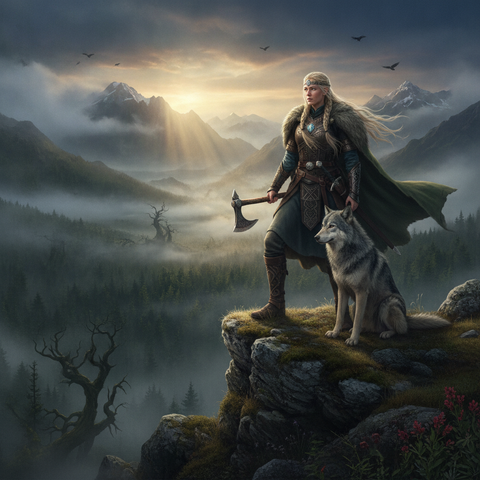
The two wolves Geri (The Ravenous) and Freki (The Greedy) share Odin's table in Valhalla. The Grimnismal, a song of the Poetic Edda, specifies that Odin lives on wine alone and gives his whole share of food to his two wolves. These animals are not servants, they are divine companions who embody primal hunger, savage strength and the warrior's appetite.
The two ravens Hugin (Thought) and Munin (Memory) fly each day across the nine worlds and return to whisper in Odin's ear what they have seen. The horse Sleipnir, with his eight legs, is the swiftest of all horses and carries Odin through the three worlds. The ring Draupnir doubles itself every nine nights and produces eight identical golden rings.
| Attribute | Nature | Mythological function | Modern symbolism |
|---|---|---|---|
| Gungnir | Magical spear | Never misses its target, seals oaths | Authority, precision, fate that strikes home |
| Geri and Freki | Two wolves | Odin's table companions in Valhalla | Wild strength, primal hunger, loyalty |
| Hugin and Munin | Two ravens | Spies and messengers across the nine worlds | Thought, memory, global vision |
| Sleipnir | Eight-legged horse | Odin's mount through the three worlds | Speed, passage between the worlds |
| Draupnir | Magical golden ring | Doubles itself every nine nights | Fertility, prosperity, cycle |
This joined-up reading is what sets Terre des Loups apart from the general Viking sites. The wolf is not only the enemy (Fenrir will devour Odin at Ragnarok), he is also the companion, the table partner, the strength that walks beside the spear. Our wolf jewellery and wolf rings pick up this mythological duality: the warrior wolf, the guardian wolf, the companion wolf.
Gungnir in popular culture (Marvel, tattoos, jewellery)
Gungnir travels through the centuries to reappear in Marvel films, video games and modern tattoos. The spear features in the Thor films of the MCU, brandished by Odin (Anthony Hopkins) and then handled by Loki in certain scenes. It also appears in the games Genshin Impact, Fate/Grand Order, Orna and God of War Ragnarok, each offering its own visual interpretation.
The Gungnir tattoo has boomed in recent years in France and Northern Europe. It stands for unshakeable determination, the aim that always finds its mark, the chosen path against all winds and tides. Among bikers, modern warriors and lovers of Norse mythology, the spear symbolises the refusal of compromise and loyalty to an ideal.
On the jewellery side, Gungnir appears as rune-carved pendants, rings with Norse motifs, treated leather bracelets. The symbol pairs particularly well with wolf imagery, since both belong to the same world of Odin.
How to choose a Gungnir pendant or piece of jewellery
To pick a Gungnir piece that will stay with you over time, four criteria really matter:
- The material: favour sterling silver 925, surgical steel or patinated bronze, which age well and stand up to daily wear.
- The size: a Gungnir pendant works best when it is visible without being oversized, between 3 and 5 centimetres in height for a balanced look.
- The runic engraving: check that the carved runes truly exist in the Futhark (the runic alphabet), not just drawn to look pretty.
- The pairing with other Norse symbols: a Gungnir combined with a wolf head (Geri or Freki) or with the ravens Hugin and Munin reinforces mythological coherence.
To explore authentic renderings, browse the Terre des Loups wolf pendants, wolf bracelets and temporary wolf tattoos. Every piece is designed to resonate with the symbols of Odin and his wild retinue.
Gungnir FAQ
How do you get Gungnir in God of War Ragnarok, Genshin Impact or Fate?
In God of War Ragnarok, Gungnir is wielded by Odin himself and is not playable. In Genshin Impact, Gungnir is a rare 4-star ancient polearm, obtainable through the wish banners. In Fate/Grand Order, Gungnir is a Noble Phantasm tied to several servants, including Odin. Each game offers its own visual and gameplay reading of the spear.
Gungnir and Mjolnir: what is the difference?
Gungnir is Odin's spear, Mjolnir is Thor's hammer. Both are forged by the dwarves, but Gungnir comes from the workshop of the sons of Ivaldi, while Mjolnir comes from the hands of the rival dwarves Sindri and Brokk. Gungnir never misses its mark and seals oaths. Mjolnir always returns to the thrower's hand and strikes with lightning. Two cardinal functions, two distinct gods.
Does a Gungnir tattoo carry a particular meaning?
Yes. A Gungnir tattoo embodies unshakeable determination and the path that always finds its mark. It is often chosen after an important decision, a turning point in life, a personal oath. Paired with runes or wolf heads, it strengthens the Norse anchoring and the symbolic coherence.
Why does Odin use Gungnir before every battle?
Odin ritually hurls Gungnir over the enemy host to dedicate it to sacrifice before every great battle. This gesture, attested in the sagas, sanctifies the fight and places the outcome before the gods. Historical Viking chiefs are said to have mimicked this rite, casting a spear over the enemy lines at the start of their campaigns.