
Niflheim: cosmology, inhabitants and role in Ragnarok
of reading - words
In Norse cosmology, Niflheim is the primordial realm of mist, ice and cold. Located to the north, beneath one of the roots of Yggdrasil, this world nurtured the very birth of life through its encounter with the fire of Muspelheim. This guide reviews everything worth knowing about this strange place: its position among the nine worlds, its inhabitants (Hvergelmir, Nidhogg, Hel), its difference with Helheim (often confused with it), and its direct link with the mythological wolves that trigger the twilight of the gods.
The essentials to remember
- Niflheim means world of mist in Old Norse (Niflheimr).
- It sits beneath the third root of Yggdrasil, to the north of Norse cosmology.
- From its well Hvergelmir spring 11 primordial rivers known as the Élivágar.
- Its encounter with Muspelheim, the world of fire, gave birth to the giant Ymir in the Ginnungagap.
- It is home to the dragon Nidhogg, the only being said to survive Ragnarok.
- The concept is chiefly described by Snorri Sturluson around 1220 in his Prose Edda.
The primordial world of mist and ice
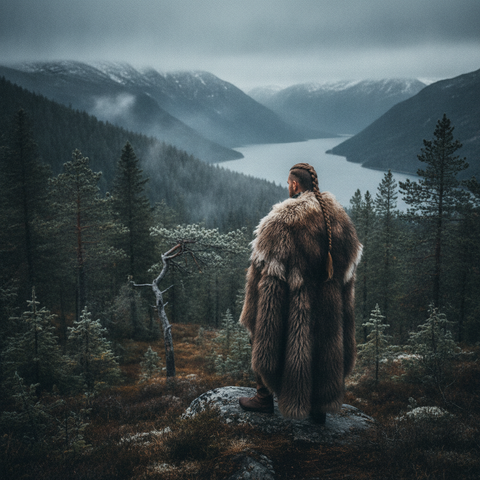
Niflheim is the Norse realm of eternal mist, absolute cold and original silence. The word comes from Old Norse Niflheimr, where nifl means "mist" or "fog" and heimr means "world" or "dwelling". It is therefore literally the "world of mist", sometimes rendered as "world of icy shadows" by 19th-century Germanic folklorists.
This realm lies to the north of Norse cosmology, beneath the third root of Yggdrasil, the world tree that binds the nine worlds together. It stands as an absolute counterpoint to Muspelheim, the world of fire and heat located to the south. The sagas evoke an endless plain covered in glaciers, where winds heavy with frost sweep across the land.
Its four fundamental features:
- A primordial cold that predates the creation of the world, older than the gods themselves.
- Everlasting icy mists that make the landscape impossible to make out.
- The silence: no echo, no bird, no cry, only the wind.
- A cosmogonic function: without this place, no life would be possible in Norse mythology.
Origin and role in the creation of the world
This realm is the cold catalyst that allowed the birth of life, when its frost met the flames of Muspelheim. Before the gods, before humans, before even Yggdrasil, there existed only the Ginnungagap, a vast yawning void. To the north of that chasm stretched the icy mist; to the south, Muspelheim, ablaze. Norse cosmogony rests on this contrast.
The creation process told by Snorri Sturluson's Edda unfolds in three stages:
- The 11 Élivágar rivers spring from the well Hvergelmir and flow toward the Ginnungagap.
- On contact with the sparks hurled by Muspelheim, the icy water of the Élivágar melts into drops which, quickened by the heat, form the first living being: Ymir, the primordial giant.
- From Ymir's sweat other frost giants are born. The primordial cow Audhumla, licking a block of salty ice, releases Buri, ancestor of the Aesir. Odin, Vili and Vé, his descendants, will kill Ymir and shape the world from his body.
This founding tale makes Niflheim one of the two cosmic poles from which all existence sprang. Without its cold, no solid matter could form; without the fire that met it, that matter would have remained inert.
The nine worlds of Norse cosmology
This icy realm is one of the nine worlds suspended among the branches and roots of Yggdrasil. The table below sums them up, along with their main inhabitants and the root of Yggdrasil to which they are attached in the most widely accepted reading of the Icelandic sources.
| World | Main inhabitants | Yggdrasil root |
|---|---|---|
| Asgard | Aesir (Odin, Thor, Frigg) | Celestial root |
| Vanaheim | Vanir (Freyr, Freyja, Njörd) | Celestial root |
| Alfheim | Light elves | Celestial root |
| Midgard | Humans | Middle root |
| Jotunheim | Giants (Jötnar) | Middle root |
| Svartalfheim | Dwarves, dark elves | Middle root |
| Muspelheim | Fire giants (Surt) | Middle root |
| Niflheim | Nidhogg, Hvergelmir, Hel (ambiguous) | Cold root (north) |
| Helheim | Non-glorious dead, goddess Hel | Cold root (north) |
This world holds an ambiguous position: some passages of the Edda equate it with the world of the non-glorious dead, others with the primordial realm predating all life. This duality lies at the heart of the scholarly debate over its actual existence in the pre-Christian Norse tradition.
Hvergelmir, Nidhogg and the rivers: the inhabitants of the icy realm
The well Hvergelmir and the dragon Nidhogg are the two cardinal figures who dwell in Niflheim. Far from empty, the icy realm teems with an underground life, unseen yet essential to the balance of the world.
At its centre lies Hvergelmir, the "bubbling cauldron". It is a huge well from which spring eleven rivers that feed the nine worlds. They are known as the Élivágar. Here are the realm's main figures and places:
- Hvergelmir: primordial well, source of all Norse rivers.
- Élivágar: the 11 rivers flowing from Hvergelmir toward the Ginnungagap.
- Nidhogg: the giant dragon that gnaws without rest at the root of Yggdrasil plunged into the mist.
- Non-glorious corpses: according to certain readings of the Edda, the bodies of those who die of illness and old age drift here to be devoured by Nidhogg.
- Icy winds: ceaseless, they drive the mist along and remind the gods that the end of times is drawing near.
Nidhogg holds a special place: he is one of the very few beings in Norse mythology said to survive Ragnarok. He appears in the Völuspá as the dragon who, after the end of times, carries corpses on his wings toward a new reborn world.
Niflheim and Helheim: what is the difference?
These two realms are distinct, often confused because of their shared position beneath the roots of Yggdrasil and their funereal mood. Snorri Sturluson himself sometimes uses the two terms interchangeably, which still fuels debate today among medievalists.
Three criteria set them clearly apart:
- Cosmological function: the first is a primordial world (predating life), Helheim is a funerary world (welcoming the dead after creation).
- Main inhabitant: the first is the domain of the dragon Nidhogg and the well Hvergelmir; Helheim is the realm of the goddess Hel, daughter of Loki, who welcomes the non-glorious dead.
- Atmosphere: primordial icy plain and emptiness on one side, fortified city of the dead with its great hall Eljúdnir on the other.
A third term circulates in the sources: Niflhel, literally "the lower part of Hel". It probably designates a border zone between the two realms. Some researchers, such as Rudolf Simek, hold that "Niflheim" could even be a late invention by Snorri, coined around 1220 to round out his systematic cosmology. The older sources would use only Niflhel and Hel.
The wolves of Norse mythology and their bond with the icy realm
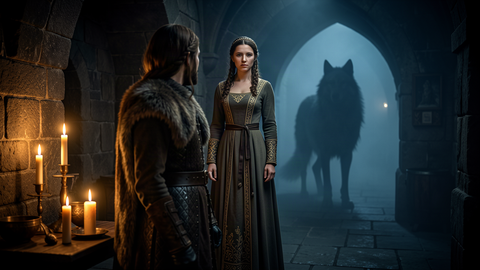
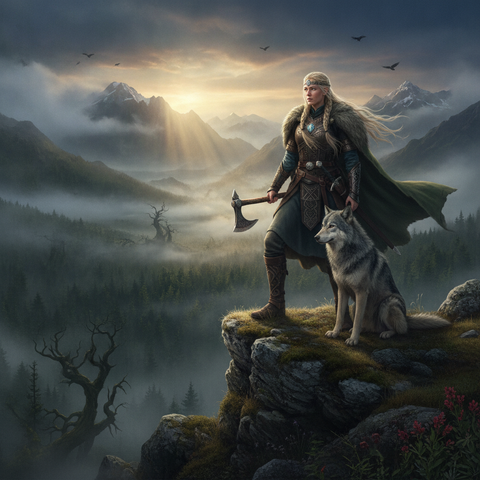
This world embodies cold and darkness, precisely the symbolic universe in which the great Norse mythological wolves move. It is impossible to grasp the power of the Viking wolves without going through the icy cosmogony of the north.
Five major wolves populate Norse mythology, all tied to the primordial chaos of which the mist is the source:
- Fenrir: the monstrous wolf, son of Loki and of the giantess Angrboda. Bound by the gods with the magical fetter Gleipnir, he is destined to break free at Ragnarok to devour Odin. His growl rings out like the north wind.
- Sköll: the wolf who pursues Sól, personification of the sun, across the heavens. He finally catches her at the outbreak of Ragnarok, plunging the nine worlds into a cold on a par with that of the primordial realm.
- Hati: brother of Sköll, he chases Máni, personification of the moon. He swallows him too at the twilight of the gods, casting Yggdrasil into utter darkness.
- Geri: "the ravenous", Odin's loyal wolf. He shares the supreme god's table in Valhalla and embodies the hunger for conquest.
- Freki: "the greedy", Odin's second wolf. Ever at Geri's side, he shows the age-old bond between the Aesir and the wolf, the totem animal of the berserkers.
The symbolism is plain: the world of mist embodies absolute cold, the mythological wolves are the forces that drive the world toward this final cold by devouring the stars and the gods. That is why the Viking craftsmen engraved their jewellery and their pictures with wolf motifs: to place themselves under the protection of these beasts older than the gods.
At Terre des Loups, this symbolism feeds a whole range of creations inspired by Norse mythology. The catalogue of wolf jewellery takes up the codes of Viking craftsmanship (interlacing, patina, Nordic motifs). The wolf pendants and necklaces let you carry the figure of Fenrir or of one of Odin's companions with you every day. Finally, the collection of wolf wall art offers pieces that recall the icy mood of the Norse realm and the power of its inhabitants.
Ragnarok: the role of the icy realm in the end of the world
At Ragnarok, this primordial world moves back to the centre: its icy forces, its dragon and its wolves converge to hasten the end of the nine worlds. The twilight of the gods begins in the Fimbulvetr, three consecutive winters without a summer that cover Midgard with ice worthy of the primordial north.
Then the events cascade: Fenrir breaks his chains, Sköll and Hati devour the sun and the moon, Loki frees himself from his bonds. Nidhogg leaves the root of Yggdrasil to soar over the battlefield of Vígríd. The frost giants born in the north march on Asgard alongside the fire giants of Muspelheim.
Five points to remember to understand Ragnarok:
- The matrix of cold triggers the Fimbulvetr, prelude to Ragnarok.
- Nidhogg leaves his root to devour the corpses of the final battlefield.
- Fenrir, born of the chaos the icy realm stands for, slays Odin during the battle.
- Sköll and Hati devour the heavenly bodies, plunging the worlds into absolute night.
- Rebirth: after the destruction, a new world emerges, but the primordial mist remains as a witness to the cosmic cycle.
The paradox is striking: this world is at once the place that made creation possible (through its encounter with Muspelheim) and the place that accompanies the end of times (through its inhabitants and its symbolism). It is the cycle-world, the alpha and the omega of Norse cosmology.
Niflheim FAQ
Here are the most frequently asked questions about this primordial Norse world, with short answers based on the Icelandic sources.
Who lives in Niflheim?
The realm is inhabited by the dragon Nidhogg, who gnaws the root of Yggdrasil, and by the corpses of the non-glorious dead according to certain readings of the Edda. The well Hvergelmir, source of 11 rivers, is found there. Some traditions also place the goddess Hel there, but she is more often linked with the neighbouring realm of Helheim.
Where is Niflheim located?
This world lies to the north of Norse cosmology, beneath the third root of Yggdrasil, the world tree. It forms the icy pole of the cosmos, facing Muspelheim, the fiery pole located to the south. This north-south opposition is central to the creation story.
What is the difference between Niflheim and Helheim?
The first is a primordial world predating life, ruled by the dragon Nidhogg and the well Hvergelmir. Helheim is the realm of the non-glorious dead, ruled by the goddess Hel, daughter of Loki. Snorri Sturluson tells them apart clearly, even if the boundary blurs in certain passages of the Edda.
Which dragon lives in the icy realm?
Nidhogg, whose name means "the night attacker", is the dragon who dwells in this place. He gnaws the root of Yggdrasil that plunges into this realm and is said to devour the non-glorious corpses. He is one of the rare beings to survive Ragnarok, appearing in the Völuspá after the rebirth of the world.
What are the 9 worlds of Norse mythology?
The nine worlds are: Asgard (Aesir), Vanaheim (Vanir), Alfheim (light elves), Midgard (humans), Jotunheim (giants), Svartalfheim (dwarves and dark elves), Muspelheim (fire giants), Niflheim (dragon Nidhogg and primordial mists) and Helheim (non-glorious dead). They are all suspended among the branches and roots of Yggdrasil.
Does this place really exist in the sagas?
The term appears almost exclusively in the writings of Snorri Sturluson around 1220. Earlier sources more readily use "Niflhel". Some researchers, such as Rudolf Simek, hold that Snorri could have created or refined this concept in order to build a systematic cosmology in his Edda. This scholarly debate has not yet been settled.