
Ubbe: the true story of Ragnar's son and his death
of reading - words
Three men carry this name and it is never the same one. There is Ubbe, Ragnar's quiet son in the series Vikings. There is Ubba, the Danish warlord of The Last Kingdom. And there is a flesh-and-blood warrior, active in England in the second half of the ninth century, whom English monks call sometimes Ubba, sometimes Hubba.
The first two are descended from the third. But between the historical figure and the men brought to the screen, a thousand years of additions have piled up. Hagiographies written to terrify, genealogies fabricated three centuries after the fact, and a screenplay that ships him off across the Atlantic.
This article sorts it out. It dates every source, says what each one claims, and flags the moments where they contradict each other. You will find what is attested, what is likely, and what was invented, including about his death, the question most often asked about him.
The key points
- Ubba existed: he commanded part of the Great Army that crushed Northumbria in 867 and took York.
- Two chronicles describe him as dux of the Frisians, not as a generic Danish chieftain.
- He most likely died in 878, at Arx Cynuit in Devon: 23 ships, 840 dead according to the Anglo-Saxon Chronicle.
- The Chronicle does not name him among the dead: it says only “the brother of Ivar and Halfdan”. The name Ubba comes from a twelfth-century text.
- His descent from Ragnar Lodbrok is a late construction: Ubba is almost entirely absent from the Icelandic traditions.
- No, he did not discover America. That was Leif Erikson, around the year 1000.
Ubbe, Ubba or Hubba: three characters for a single name
The same man hides behind three faces, and the confusion between them explains most of the errors you will read about Ubbe. First things first: who is who.
- Ubbe Ragnarsson, the series Vikings (History, 2013-2020), played by Jordan Patrick Smith. Eldest of the sons of Ragnar Lodbrok and Aslaug, brother of Hvitserk, Sigurd and Ivar, half-brother of Bjorn. Husband of Torvi. His arc ends on the far side of the ocean.
- Ubba, the series The Last Kingdom (BBC, then Netflix, 2015-2022), played by Rune Temte. A brutal Danish chieftain obsessed with omens, come to take control of England.
- Ubba, the historical figure, died 878. A Viking leader active in England, mentioned for the first time in a text from the end of the tenth century.
Both fictional characters draw on the same figure: the writers of the two shows dug into the same Anglo-Saxon file, which is why anyone moving from one series to the other feels they are watching two different men. Ubbe also appears in the game Assassin's Creed Valhalla, alongside his brother Ivar.
One detail is enough to measure the gap between these versions: in Vikings, Ubbe is the level-headed one, the brother who wants peace and land. In the English chronicles, he is the pagan invader in its purest form, named in the bloodiest martyrdom stories of the insular Middle Ages.
Ubba the Viking leader: what the medieval sources actually say
Ubba is not a figure of legend: he appears in historical chronicles, but always late and never from the hand of a contemporary. That nuance is exactly what almost every page written about him leaves out.
A Frisian commander, not a generic Dane
Two texts, the Annales Lindisfarnenses et Dunelmenses and the Historia de sancto Cuthberto, describe him as dux of the Frisians. The detail matters and is almost never picked up: in these sources Ubba is not a generic Dane but the leader of a Frisian contingent. We know, after all, that several Viking commanders held benefices in Frisia on behalf of the Franks, and that the Great Army was no homogeneous Scandinavian bloc.
The Anglo-Saxons called that army micel here, literally the “great host”. Excavations and texts point the same way: it was a coalition of war bands from Scandinavia, Ireland, the Irish Sea and the Continent, not a unified army.
What he commanded, and when
Ubba's role in that coalition is established by several texts. The same two chronicles place him at the head of the army that crushed the Northumbrian kings Ælla and Osberht in 867, after the capture of York, one of the country's two archiepiscopal seats and one of its richest trading centres. The Historia regum credits the conquest of Northumbria to three named leaders: Ivar, Halfdan and Ubba.
The hierarchy of the sources
Here is the honest hierarchy of the sources that mention him.
| Source | Written | Distance from the events | What it says about Ubba | Reliability |
|---|---|---|---|---|
| Anglo-Saxon Chronicle | 9th-12th c. | Contemporary for its core | Does not name him in 878, speaks of “the brother of Ivar and Halfdan” | High |
| Passio sancti Eadmundi (Abbo of Fleury) | Late 10th c. | About 120 years | First text to name him; leaves him in Northumbria in 869 | Medium |
| Historia de sancto Cuthberto | 10th-11th c. | 100 to 200 years | Calls him dux of the Frisians | Medium |
| Annals of St Neots | 11th-12th c. | 200 to 300 years | Calls him brother to three daughters of Lodbrok, mentions the Reafan banner | Low |
| Annales Lindisfarnenses et Dunelmenses | 11th-12th c. | 200 to 300 years | Dux of the Frisians, conqueror of Northumbria | Low |
| Estoire des Engleis (Geffrei Gaimar) | 12th c. | About 280 years | Identifies him as the leader killed in 878, has him buried at Ubbelawe | Low |
| Gesta Danorum (Saxo Grammaticus) | Around 1200 | More than 320 years | Son of Ragnar, rebels against his father, never in England | Very low |
The table leaves little room for doubt: the richer a source is in detail about Ubba, the later it is. The texts closest to the events are also the most sparing.
The martyrdom of Edmund: the legend that made Ubba's name
It is a martyrdom story, written more than a century after the events, that lifts Ubba out of anonymity and turns him into the textbook enemy of Christendom. Without it, his name might never have crossed the centuries.
In the autumn of 869, the Great Army invaded the kingdom of East Anglia and took winter quarters at Thetford. King Edmund died. The Anglo-Saxon Chronicle, like the Vita Alfredi, says he was killed in battle, with no torture scene at all. But a hagiographic legend grew up very quickly: that of a peaceable king refusing to shed blood and accepting martyrdom.
The founding text is the Passio sancti Eadmundi, written towards the end of the tenth century by Abbo of Fleury, a Frankish monk. It is the oldest known text to mention Ubba. And it says something almost nobody points out: according to Abbo, Ubba stays in Northumbria while Ivar leads the conquest of East Anglia. So he is not present at Edmund's death.
Three centuries later, manuscript F of the Anglo-Saxon Chronicle instead places the two men side by side and makes them jointly responsible for the martyrdom. Later texts take up that version, and it becomes the popular one.
Æbbe of Coldingham and Osgyth: two unverifiable stories
Ubba also appears in two further saints' lives, those of Æbbe of Coldingham and Osgyth, in Essex, where he leads the armies that sack their monasteries. The stories are spectacular: Æbbe is said to have ordered her nuns to mutilate their faces to preserve their virginity, cutting off her own nose and upper lip with a razor, before being burned alive with her sisters.
Three reasons make it impossible to take them seriously.
- The Osgyth anachronism: she is supposed to have lived in the seventh century, long before the first Viking raid on England. She could not have crossed paths with Ubba.
- The silence of the early texts: Æbbe's story appears in no document earlier than the thirteenth century, almost four hundred years after the supposed events.
- The literary model: Abbo of Fleury's descriptions of Vikings owe a great deal to an account of a raid on the Loire written by another Fleury monk. These are recycled motifs, not eyewitness reports.
Over time, Ivar and Ubba become a pair, the archetype of the pagan invader. What makes them famous is precisely what makes them so hard to pin down.
Arx Cynuit, 878: how Ubbe died
Ubba most likely died in battle in Devon, in the spring of 878, in an engagement the Vikings lost outright. That is the answer to the question most often asked about him, and it deserves unpacking, because it holds a surprise.
The background: the winter Alfred nearly lost everything
The setting is the worst year of Alfred the Great's reign. During the winter of 877-878, Guthrum launched a surprise attack out of Gloucester, drove deep into Wessex and sacked the royal estate at Chippenham. Alfred took refuge in the Somerset marshes.
At the same moment, a Viking fleet out of Dyfed, in Wales, landed in Devon. The two operations look coordinated, a pincer meant to finish off the cornered king. That second army was wiped out at Arx Cynuit, a fortress the Vita Alfredi places at what is now Countisbury, in north Devon. The victor is named by the Chronicon Æthelweardi: Odda, ealdorman of Devon.
The numbers behind the battle
The figures given by the Anglo-Saxon Chronicle are worth pausing over: 23 ships and 840 dead on the Viking side. That works out at roughly 36 men per ship, an order of magnitude perfectly consistent with the Gokstad ship, a ninth-century Norwegian vessel with 32 oars. Nothing here smells of a chronicler's exaggeration.
The detail nobody mentions
Now comes the point that never gets made. The Anglo-Saxon Chronicle never names the leader who was killed. It calls him only “the brother of Ivar and Halfdan”. Identifying that man as Ubba appears for the first time in the Estoire des Engleis, a twelfth-century chronicle, nearly three hundred years later. Whether its author had access to a lost source or simply inferred the name from the already established pairing of Ivar and Ubba, we cannot say.
The same text adds two valuable details. Ubba is said to have fallen at a place called the wood of Pene, perhaps Penselwood, on the border of Somerset and Wiltshire. And to have been buried in Devon, under a barrow called Ubbelawe, “Ubbe's mound”.
Timeline, 865 to 878
Here is the full sequence of events.
- 865: the Great Army winters in East Anglia and obtains horses from the subjected population.
- 866-867: York is taken, then kings Ælla and Osberht are crushed. Ubba is named among the victors.
- 869: conquest of East Anglia, death of King Edmund. Whether Ubba was there depends on the source.
- 873: the Great Army splits. Halfdan settles in Northumbria, Guthrum heads south.
- Winter 877-878: Guthrum strikes Chippenham, Alfred falls back into the marshes.
- Spring 878: landing in Devon, disaster at Arx Cynuit, death of the brother of Ivar and Halfdan.
- May 878: Alfred gathers his troops and breaks Guthrum at Edington. Guthrum is baptised.
The defeat in Devon very probably left Guthrum overextended. A few weeks later, Alfred turned the whole campaign around.
The Reafan raven banner, trophy and riddle
The victors of Arx Cynuit did not simply kill a chieftain: they captured a banner, and that object is the most intriguing item in the whole file.
The Annals of St Neots, an eleventh or twelfth-century text, relate that three daughters of Lodbrok had woven a magic banner named Reafan, and that it was taken during the battle. Some versions of the Anglo-Saxon Chronicle independently confirm the capture of a raven banner named Hræfn, the Old English word for raven, but credit it with no power whatsoever.
Two independent texts, one sober and one full of wonders, therefore describe the same trophy. That is exactly the kind of overlap that gives a detail weight.
In a Viking army, a banner is no ornament. It serves three concrete purposes:
- A rallying point you can see in a melee where the sides are no longer distinguishable.
- The leader's sign: the banner falls when the leader falls, and the army knows it.
- A symbolic war prize: seizing it announces that the enemy line has been defeated, not merely its men.
These annals are also the first text to link Ubba explicitly to the line of Lodbrok. In other words, the most famous piece of parentage in Viking history first appears in the same document as the magic banner. That alone should counsel caution.
Wolf and raven, the beasts of battle of the North
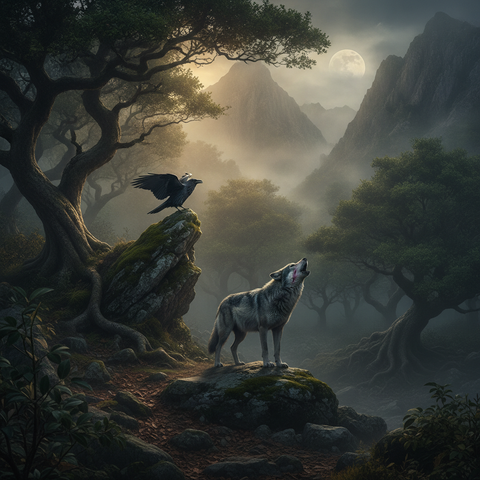
The raven on the banner never walks alone in the Norse imagination: the wolf goes with it everywhere, and that pairing says everything about how these men saw war.
Old English and Old Norse poetry insistently deploy a motif specialists call the beasts of battle: the wolf, the raven and the eagle, who follow armies and wait for the fighting to end. Announcing their arrival, in a poem, is a way of announcing the slaughter without describing it. The device is so constant that it works as a signature of the genre.
This is no isolated poetic flourish. Odin himself is flanked by these beasts. Two wolves, Geri and Freki, feed at his feet in Valhöll, and the god gives them all his food, taking only wine himself. Two ravens, Huginn and Muninn, Thought and Memory, roam the world each day and return to speak in his ear.
The lord of the battle-slain is thus surrounded by exactly the two animals that haunt the battlefield. Nothing in that symmetry is accidental: the raven sees and reports, the wolf accompanies and devours. One is the god's intelligence, the other his hunger.
That is why the wolf remains, a thousand years on, the most heavily charged symbol of this imagination. It does not stand for brutality, but for belonging to a pack and standing beside those who fight. Anyone wearing a wolf pendant today is extending, often without knowing it, an association more than a thousand years old. To understand exactly where Geri and Freki fit into Odin's equipment, our article on Gungnir and Odin's wolves covers the whole picture.
Ubba's raven banner is therefore not an emblem picked at random by a warlord. It is the visible half of a symbolic pair whose other half runs through the forest.
Was Ubbe really a son of Ragnar Lothbrok?
Almost certainly not, at least not in any genealogical sense: Ubba's descent from Ragnar is a literary construction that appeared at least two centuries after his death. That is where all the sources lead, once put back in order.
The Passio sancti Eadmundi, the first text to name him, records no family tie between Ubba and Ivar. The two men act together, and that is all. The earliest source to make them brothers is the Annals of St Neots, in the eleventh or twelfth century, the very text that tells of the banner woven by three daughters of Lodbrok.
What the Scandinavian tradition says
On the Scandinavian side, Saxo Grammaticus, around 1200 in the Gesta Danorum, does make Ubbe a son of Ragnar and the daughter of a certain Hesbern. But his account bears no resemblance to the English one: there Ubbe rebels against his father, egged on by Hesbern, and never sets foot in England.
The decisive point lies elsewhere, and it is rarely cited. Ubba is almost entirely absent from the Icelandic traditions devoted to the sons of Ragnar. The sagas of that branch, which form the richest body of material on the legend, grant him no son corresponding to Ubba. He exists only in the East Scandinavian branch, the one Saxo belongs to.
A few markers to keep your bearings:
- Ragnar Lodbrok is himself a figure of doubtful historicity, probably an amalgam of several ninth-century men.
- The English sources set the legend in East Anglia, the Scandinavian ones in Northumbria. They are not telling the same story.
- A late Icelandic text, the Ragnarssona þáttr, gives Ivar two illegitimate brothers named Yngvar and Husto, who may be Ivar and Ubba garbled in copying from English sources.
One appealing hypothesis would explain the invention: the legend of Ragnar may have served to give a noble motive, a father to avenge, to what began as a straightforward enterprise of conquest and settlement. For a full portrait of the supposed father, see our portrait of Ragnar Lothbrok.
None of this takes anything away from Ubba. He commanded men, took kingdoms and died in battle. He had no need of a famous father.
Ubbe in the series Vikings: what the fiction adds
The show keeps the name, the brothers and the period, then builds pretty much everything else. Which is not a criticism, but is worth knowing.
In Vikings, Ubbe is played by Jordan Patrick Smith from the second half of season 4 onwards. Eldest of the sons of Ragnar and Aslaug, he is the brother of Hvitserk, Sigurd and Ivar, and half-brother of Bjorn. He marries Torvi in season 5, after her separation from Bjorn, and his arc takes him west, in search of a new land, all the way to an unknown shore.
Did Ubbe discover America?
That last image prompts the question again and again: did Ubbe discover America? No. The first European to reach North America was Leif Erikson, around the year 1000, more than a century after Ubba's death. The only authenticated Norse site on the continent is L'Anse aux Meadows, in Newfoundland. Ubbe's crossing is a writers' choice, not a historical episode.
| Element in the series | What the sources say | Verdict |
|---|---|---|
| Ubbe is Ragnar's son | Asserted only from the eleventh century, absent from the Icelandic sagas | Late construction |
| Brother of Ivar | No kinship in the oldest text | Not originally attested |
| Takes part in the Great Army | Confirmed by three separate chronicles | Attested |
| Present at King Edmund's death | Abbo of Fleury places him elsewhere, a twelfth-century text puts him on the spot | Contradictory |
| Survives the series and sails west | Most likely died in Devon in 878 | Invented |
| Discovers America | Leif Erikson, around the year 1000 | False |
| Husband of Torvi | No medieval source mentions a wife | Invented |
The resemblance to Ragnar, and the other Ubba
That leaves the question of the resemblance to Ragnar. In the series it is a narrative device: Ubbe inherits his father's calm and curiosity, where Ivar inherits his violence. No source describes the appearance or the character of the historical man. That resemblance is pure screenwriting.
As for The Last Kingdom, its Ubba and the Ubbe of Vikings really are the same historical figure, handled by two teams that made opposite choices: a superstitious brute on one side, a thoughtful peacemaker on the other.
Wearing Ubbe's legacy: Norse symbols and the wolf
A Norse symbol is only worth wearing if you know what it says. Ubba's raven, Odin's wolves, the runes: these motifs circulate widely and often carelessly. Here is how to choose without going wrong.
- Check what the motif actually stands for. A raven, a wolf, a valknut and a hammer do not say the same thing. The wolf points to the pack and to presence, the raven to sight and memory.
- Prefer an attested symbol to a show's logo. A motif taken from the sources outlives fashions, a series emblem ages with the series.
- Choose the metal to suit your complexion. Silver and steel support cool tones, bronze and brass warm up golden ones. A wolf jewel is worn every day: the colour of the metal counts for more than the fine detail of the relief.
- Weigh use before looks. A wolf ring with strong relief catches on pockets and sleeves; a signet ring with an engraved motif is more discreet day to day.
- Avoid decorative runes with no meaning. A runic inscription lined up at random is spotted instantly by anyone who knows the futhark. If you want text, choose a real word.
- Compare the registers before deciding. A wolf sweatshirt with a large motif states far more than a discreet pendant. Both work, but not in the same settings.
One last marker: Norse objects recovered from excavations are almost always plain and well worn. Spectacular pieces exist, but most of what these men and women wore day to day came down to a simple motif, repeated, and worn smooth by time. That makes a good aesthetic compass.
FAQ: Ubbe and the sons of Ragnar
How did Ivar the Boneless die?The sources diverge and stay vague. The Anglo-Saxon Chronicle and the Irish annals place the death of a Viking leader named Ivar around 870-873, without describing the circumstances. In the series Vikings, Ivar dies in battle in England facing the Saxons, which is a writing choice with no documentary equivalent.
Who is Bjorn's real father?In the series, Bjorn is the son of Ragnar and Lagertha. Historically, Bjorn Ironside is himself a saga figure whose existence is debated, and his descent from Ragnar belongs to the same late legendary corpus as Ubba's. No contemporary chronicle connects them.
Is Magnus really Ragnar's son?Magnus is a character in the series, presented as the son of Ragnar and Queen Kwenthrith of Mercia, and his paternity is itself cast into doubt there by the other characters. No medieval source knows of him.
When did Rollo die?The historical Rollo, founder of the duchy of Normandy after the treaty of Saint-Clair-sur-Epte in 911, died around 928-933. He was not Ragnar's brother: the series gives him a kinship that exists in no text.
Who is Ragnar's favourite son?The question only makes sense within the series, where Ragnar has a special bond first with Bjorn and then with Ivar. The medieval sources do not rank his sons and, in Ubba's case, do not even guarantee the parentage.
Are Ubbe from Vikings and Ubba from The Last Kingdom the same person?Yes, both characters go back to the same historical Viking leader who died in 878. The two shows drew on the same Anglo-Saxon file and produced opposite portraits from it: The Last Kingdom keeps the invader of the hagiographies, Vikings invents a thoughtful son and builder.