
Aegishjalmur: the true meaning of the Helm of Awe
of reading - words
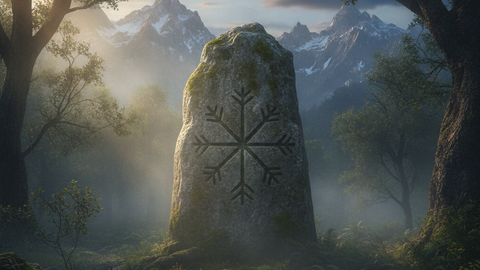
Eight prongs bristling with tridents, turned outwards like a ring of spears. The Aegishjalmur is today the most widely worn Norse symbol of protection, on jewellery, on clothing and in tattoo work, just behind the Vegvisir and the Valknut. It is also the one most consistently misrepresented. Almost every page in English claims that Viking warriors painted it on their foreheads before battle. The sources say something else, and that something else is far more interesting. You are about to see where this design actually comes from, what the Norse texts really call an Aegishjalmur, how to stop confusing it with the Vegvisir, and what to look at before buying one.
The key points:
- Aegishjalmur literally means "helm of awe", which is why English uses Helm of Awe and Helm of Terror.
- In the texts of the Viking Age it is not a design but an object, worn by the dragon Fáfnir.
- The eight-armed design you know is an Icelandic magical stave, documented in grimoires from the 17th century.
- It protects and intimidates, whereas the Vegvisir guides: the two symbols share neither function nor date.
- It is a symbol of protection, not an alphabet: the Aegishjalmur is not a rune.
The Aegishjalmur, the Norse symbol of protection in one sentence
The Aegishjalmur is a symbol of protection and intimidation from Norse culture, and its name means "helm of awe".
The word is written Ægishjálmur in Icelandic and Ǿgishjalmr in Old Norse. You will also meet it in the simplified spelling Aegishjalmur, without the ligature, and above all under its English name Helm of Awe. Older translators render it Helm of Terror, or Fear-helm.
The etymology is perfectly clear, and it tells you everything about the symbol. The name is built from two Old Norse elements: œgir, "the one who terrifies", from agi, a word for dread mixed with respect, and hjálmr, "helmet". A helmet that terrifies. Nothing passive about it: the Aegishjalmur works on the opponent as much as on the person wearing it.
One point almost no English page makes clear: there are in fact two Aegishjalmur. On one side an object, cited in the medieval Norse texts. On the other a design, born in Iceland far later. Conflating the two is the mistake that circulates everywhere, and untangling it is exactly what the next section does.
From Fáfnir's hoard to the Icelandic grimoires: the real timeline
The object belongs to the texts of the Viking Age, but the eight-armed design is documented roughly six centuries later, in Icelandic grimoires.
The object: treasure guarded by a dragon
In the Völsunga saga, the Aegishjalmur is one of the items the hero Sigurd carries off from Fáfnir's hoard after killing the dragon. The prose of Reginsmál states that Fáfnir owned this helm and that every living creature feared it. The motif returns in Fáfnismál, a poem of the Poetic Edda, at stanzas 16, 17 and 19, where English translators render it as "Fear-helm".
In other words, nowhere in the Viking Age corpus is the Aegishjalmur described as a drawing. It is a piece of treasure, worn by a dragon, and its power is the terror it inspires.
The design: an Icelandic magical stave
The geometric symbol you see on pendants belongs to another family: the galdrastafir, the Icelandic "magical staves". These symbols spread through Iceland in the 16th and 17th centuries, fed by Latin grimoires arriving from the continent such as the Liber Razielis Archangeli and the Clavis Salomonis, against the backdrop of Lutheranism being imposed by the Danish crown from 1550 onwards.
The Galdrabók, an Icelandic grimoire dated to around 1600, gathers 47 spells and magical staves, compiled by four successive scribes. But the most famous version of the eight-armed design, the one that decorates jewellery today, comes from another manuscript: the Galdrakver, dated to about 1670.
| Period | What is attested | Source |
|---|---|---|
| Viking Age, up to around 1066 | The Aegishjalmur as an object, worn by Fáfnir | Völsunga saga, Reginsmál, Fáfnismál |
| 15th century | Greek pentacles of very similar shape | Hygromanteia, earliest manuscripts |
| Around 1600 | Galdrabók, 47 spells and magical staves | Icelandic grimoire |
| Around 1670 | The most famous eight-armed design | Galdrakver |
| 1860 | First attestation of the Vegvisir | Huld manuscript |
Researchers Alessia Bauer and Alexandra Pesch published a landmark study of these symbols in 2023. Their conclusion deserves to be quoted as it stands: neither the names nor the forms of these figures were ever standardised. Several different designs carry the name Aegishjalmur, and very similar figures circulate under other names, such as Þórshamar, Thor's hammer, or Þjófastafar, the staves meant to expose thieves.
This timeline takes nothing away. It simply moves the symbol: it is not the amulet of a warrior from the year 1000, it is the witness of an Iceland that went on manufacturing its own magic for centuries under religious pressure.
How to read the eight arms of the Helm of Awe
The design reads from the centre outwards: a point to be protected, and eight arms repelling whatever comes from any direction.
The structure is always the same in its broad lines. Eight arms radiate from a single centre, along the four cardinal directions and the four diagonals. Each arm ends in a trident shape, sometimes crossed by perpendicular bars that give it the look of a harrow.
The symbolic reading follows directly from that geometry. The centre is the person wearing the symbol. The arms point outwards, never inwards: they do not hold in, they push away. And the fact that there are eight of them rather than four means no angle is left open. It is a 360 degree symbol of protection, and that is also what explains its second register, intimidation.
What the Aegishjalmur is not, on the other hand, deserves saying plainly:
- It is not a rune, nor an assembly of Futhark runes: runes form an alphabet, the Aegishjalmur is a single figure.
- It is not a symbol with a fixed shape: the Icelandic manuscripts give several variants of it.
- It is not exclusively Norse in its graphics: the closest parallel identified by research is Greek.
- It is not a protection rune in the sense the shops use the phrase, meaning an isolated character credited with a power.
On that last point, the trail is fascinating. The closest graphic parallel spotted by Bauer and Pesch sits in a series of pentacles from a Greek text, the Hygromanteia, whose earliest manuscripts date from the 15th century and are held notably at the British Library. So the best-selling Norse symbol in the world has, as its nearest relative, a seal of Mediterranean learned magic.
As for the gesture reported everywhere, tracing the symbol on the forehead between the eyebrows to activate its protection, it is real, but it needs placing: it comes from the instructions in the Icelandic grimoires, not from a Viking manual of war.
Aegishjalmur or Vegvisir: time to stop mixing them up
The Aegishjalmur protects and intimidates, the Vegvisir guides: two symbols with opposite functions and different dates.
This is the most common confusion, and it is kept alive by shops selling the two side by side. The table settles the question.
| Criterion | Aegishjalmur | Vegvisir |
|---|---|---|
| Function | Protect and intimidate | Guide, never lose your way |
| Literal name | Helm of awe | The one that shows the way |
| Attestation of the design | Galdrabók around 1600, Galdrakver around 1670 | Huld manuscript, 1860 |
| Presence in the Norse texts | Yes, as an object, in the Poetic Edda | None |
| Shape | Eight radiating arms ending in tridents | Eight different staves around a centre |
| Common misleading label | Viking rune of protection | Viking compass |
The Vegvisir is attested only in the Huld manuscript, a collection of occult symbols gathered in Iceland in 1860. The manuscript spells out the promise itself: whoever carries this sign will never lose their way in a storm, even on an unknown road. No earlier attestation exists, which makes the label "Viking compass" frankly abusive, since it places an item from 1860 eight centuries too early.
That leaves the third member of the most requested trio, the Valknut, those three interlaced triangles associated with Odin. Unlike the other two, that one really does appear on carved stones from the Viking Age. Three symbols, three different documentary statuses: which is exactly why it is worth knowing which one you are wearing.
Aegishjalmur and Norse wolves: the same family of symbols
The wolf and protection belong to the same Norse imagination, which is why the two sets of imagery sit so well together.
Norse mythology does not separate the threat from the guard: it embodies both in the same animals. Fenrir is the chained wolf who, at Ragnarök, breaks his bonds and devours Odin. Skoll and Hati are the two wolves who chase the sun and the moon across the sky without respite. And Geri and Freki, whose names mean roughly "the greedy one" and "the ravenous one", are the two wolves who accompany Odin himself and to whom the god gives his entire share of food.
The same god owns the wolves, the ravens and the knowledge of the magical signs. Looking for a Norse symbol of protection and loving wolf imagery are therefore not two separate tastes: it is the same body of material, read through two different doors. An Aegishjalmur says "no one reaches me". A wolf says "I am one of those who do not get caught". The kinship is immediate.
That is why the same people wear both. If this family of symbols speaks to you, our Norse-inspired wolf jewellery explores the same register, and the wolf pendants are its most direct piece, worn as close to the chest as the talisman once was.
Wearing the Aegishjalmur: jewellery, clothing or tattoo
Three supports dominate today, and each imposes its own legibility constraints on the design.
The pendant and the ring are the talisman's historic supports, because they are worn against the body. The trap there is technical: the eight arms and their cross bars need surface. Under 20 millimetres in diameter, an engraved Aegishjalmur turns into a grey smudge where nothing reads any more. Our wolf rings show this trade-off between fineness of motif and real legibility on the finger very well.
Fabric offers the opposite: room, so a crisp design, but a symbol that is visible from a distance and makes a statement. It is the simplest support for living with the motif before committing further, as with our wolf t-shirts for Norse imagery in general.
The tattoo, finally, is the most requested support and the most permanent. The temporary version exists for precisely that reason, and our temporary wolf tattoos let you test a placement and a size for a few days before deciding. It is the most sensible option for a symbol of this graphic density, which copes badly with small formats.
As for the ritual gesture described in the grimoires, the tracing on the forehead between the eyebrows, it keeps its value as a historical reference. It simply belongs to the instructions of a 17th century Icelandic manuscript, not to any documented warrior practice.
What to check before buying an Aegishjalmur
Five checks are enough to rule out the great majority of badly drawn pieces.
The symbol has become so common that many pieces reproduce a degraded design, copied from image to image until the structure is lost. Here is the list to run through:
- Check the symmetry of the eight arms: they must radiate at regular intervals, cardinals and diagonals, with no arm longer than another.
- Compare the cross bars from one arm to the next: every arm must carry the same number of perpendicular bars, otherwise the motif has been redrawn by guesswork.
- Choose a diameter of at least 20 to 25 millimetres for an engraved pendant, failing which the detail disappears with the first patina.
- Avoid pieces sold as an authentic Viking rune: a seller who writes that knows neither the dating of the symbol nor the difference between a rune and a magical stave.
- Ask for the chain length when it is not stated, since a medallion of this graphic density sits better mid-chest than tight at the neck.
One last marker, simpler than all the others: look at what the seller says about the symbol. A shop that correctly places the Aegishjalmur between the Iceland of the grimoires and the Old Norse texts has usually taken care over its drawing as well.
A symbol that has been appropriated: what you should know
Like several Norse symbols, the Aegishjalmur has been co-opted by far-right movements, and it is useful to know that before wearing it.
The phenomenon is documented. Bauer and Pesch note that, just as Icelanders had appropriated the grimoire tradition and given it new meanings, contemporary groups claim in their turn the right to reinterpret these figures. The most cited case is the flag of a Swedish neo-Nazi party, whose graphics are considered partly inspired by the Aegishjalmur.
This takes nothing away from the symbol and does not turn it into a political sign. The Aegishjalmur belongs to the religious and magical history of Iceland, and then to a global popular culture where it decorates jewellery and t-shirts. But knowing that this appropriation exists gives you two useful things: the means to understand a possibly surprised look, and the ability to choose knowingly the context in which you wear it.
Your questions about the Aegishjalmur
The five questions readers ask most often, each with a direct answer.
What is the meaning of the Aegishjalmur?
Aegishjalmur means "helm of awe", from œgir, the one who terrifies, and hjálmr, helmet. It protects whoever wears it and intimidates whatever approaches. In English it is called the Helm of Awe or the Helm of Terror.
What is the meaning of the Vegvisir?
Vegvisir means "the one that shows the way". It is a symbol of guidance, not of protection. The Huld manuscript of 1860, the only source that attests it, promises whoever carries it that they will never lose their way in a storm.
Which is the best known Viking symbol of protection?
For protection, the Aegishjalmur is the most widely worn today, with around 480 monthly searches on its name alone in France. The Valknut and Thor's hammer are attested earlier, but their primary function is not protective.
Which is the most powerful rune of protection?
The question rests on a common misunderstanding. The Aegishjalmur, the Vegvisir and the other galdrastafir are not runes: they are whole magical figures, not letters. No Norse text ranks runes by power.
What is the meaning of the Norse triangle?
The Norse triangle usually refers to the Valknut, three interlaced triangles associated with Odin and with warriors fallen in battle. Unlike the Aegishjalmur, it does appear on carved stones from the Viking Age.