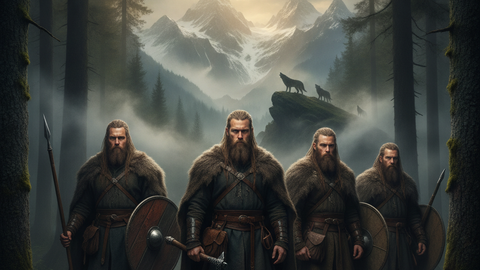

The Viking kings named Harald: four men, one name
of reading - words
You have seen a king called Harald on screen and you want to know who he really was. The trouble is that the Viking kings named Harald are four men, not one. In the series Vikings, Harald is the blond-braided king of Vestfold who dreams of ruling the whole of Norway. In Vikings: Valhalla, a different Harald crosses the North Sea a century and a half later. And behind those two stand two entirely real rulers, separated by almost two hundred years.
Most pages online cheerfully mix the four of them up. Harald I, Harald III and Harald Bluetooth share neither the same century, nor the same kingdom, nor the same end. Each page handles its own Harald and forgets the others, so a viewer after a simple answer walks away with three contradictory versions.
This article sorts the Haralds out one by one. It dates every source, separates what the saga tells from what historians argue, and answers the questions you are actually asking: who plays whom, who is whose brother, and how each one dies. You will also discover that the only text written in the first Harald's lifetime is also the oldest Norse text to speak of men clad in wolf skins.
The essentials
- Four Haralds share the name: the character from the series Vikings, the historical king Harald I, the Harald of Vikings: Valhalla, and Harald Bluetooth, king of Denmark.
- In the series, Halfdan is Harald's younger brother. In history, Halfdan the Black is his father.
- The date of 872 for the unification of Norway is an estimate worked out in the 1830s. Researchers now place the battle of Hafrsfjord in the 880s.
- The only text contemporary with King Harald, the poem Haraldskvæði, is the oldest known attestation of the word berserkr, and it calls his warriors úlfheðnar, the ones clad in wolf skins.
- Harald Hardrada dies on 25 September 1066 at Stamford Bridge, the date conventionally taken as the end of the Viking Age.
- The Bluetooth logo is a bind rune formed from Harald Bluetooth's initials.
Four Haralds, one name: the key to reading them
Harald was no rare name among the Scandinavians of the early Middle Ages, it was a dynastic name, and four major figures carry it in the Viking world. Let us set out the grid before telling any story.
| Who | Dates | Where you saw him | Played by | Death |
|---|---|---|---|---|
| Harald Fairhair (character) | fiction | Series Vikings, seasons 4 to 6 | Peter Franzén | Season 6, episode 19 |
| Harald I Fairhair | c. 850 - c. 932 | History of Norway | - | In Rogaland, grave never found |
| Harald Sigurdsson (character) | fiction | Vikings: Valhalla, Netflix | Leo Suter | Series ended in 2024 |
| Harald III Sigurdsson, called Hardrada | 1015/1016 - 1066 | History of Norway | - | Stamford Bridge, 25 September 1066 |
| Harald I of Denmark, called Bluetooth | c. 910 - 985 | History of Denmark | - | Jomsborg, 1 November 985 |
Two markers so you never mix the Viking kings up again. The Harald of the series and the Harald of Valhalla are a hundred and fifty years apart. The Harald of the series Vikings is Norwegian and ninth-century: he is the king of the unification. The Harald of Vikings: Valhalla is Norwegian and eleventh-century: he is the king of the ending. Between them lie a hundred and fifty years and a world that had swung over to Christianity.
Harald in the series Vikings: the king who wanted all of Norway
In Vikings, Harald Fairhair is played by Peter Franzén and turns up from season 4 onwards, as the king of Vestfold set on ruling the whole of Norway. That is the answer to the question most often asked on the subject.
His arc comes down to a handful of turning points:
- Season 4: he joins Ragnar for the second raid on Paris. His ambition is spelled out in his very first scene, along with his plan to marry Ellisif.
- The Great Heathen Army: he takes part in the invasion of England and faces Ælla, then Æthelwulf.
- Kattegat: he fails to seize the place. On learning that Ellisif is married, he kills her husband, then abducts and marries Astrid.
- Astrid dies in battle and Harald swears vengeance on Lagertha.
- The expedition with Bjorn: the fleet is broken by a storm, Harald saves Bjorn's life and comes out of it badly wounded. Olaf rescues him but occupies Vestfold.
- The election: Olaf wants Bjorn elected high king of Norway. Harald wins instead.
He dies in season 6, episode 19, the second to last of the series. That longevity explains a feeling viewers often put into words: a character who runs through the entire second half of the saga without ever quite taking the lead.
The series presents him as a complicated rival rather than a straightforward enemy: Ragnar's ally, Lagertha's foe and Bjorn's saviour by turns. That is a writers' reading, not a historical fact.
Are Halfdan and Harald brothers? The awkward answer
In the series, Halfdan the Black is Harald's younger brother. In history, Halfdan the Black is his father. The reversal is total, and it is probably the biggest liberty the writers took with this character.
Three gaps worth knowing:
- The family tie. Halfdan the Black, king of Vestfold, dies and leaves the throne to his son Harald, then about ten years old according to Heimskringla. The young king leans first on his maternal uncle Guthorm Sigurdsson, who acts as regent.
- A composite character. The Halfdan of the series, played by Jasper Pääkkönen, also borrows traits from the Viking chieftain Hasting. So he is not a portrait, he is an alloy.
- The fratricide. The series has Harald kill Halfdan himself. No medieval text tells anything of the kind, for a simple reason: the historical Halfdan died before his son ever reigned.
Keep the general rule in mind: with the Haralds as with the other characters in the series, family ties are reshuffled to suit the story. Harald belongs there to a generation and a family network rebuilt for narrative purposes. Whenever a family tie in the series surprises you, the odds are good that it was invented.
Harald I Fairhair: what the sources really say
The historical king did exist, but almost everything told about him comes from a text written more than two hundred and fifty years after his death. That is the nuance nearly every page on the subject forgets to set out.
Born around 850, son of a petty king of Vestfold, dead around 932. The name he actually went by in his lifetime was most likely Harald Halfdansson, Harald son of Halfdan, following Scandinavian custom. The nickname comes from the skalds: the poet Þorbjörn Hornklofi sings of him as Haraldr hárfagri, which English renders as Harald Fairhair, the form you meet in the credits and the wikis of the series.
As for the famous vow never to cut or comb his hair until he was king of Norway, it is reported by Snorri Sturluson, who puts it down to a piece of advice from Gyda Eiriksdatter, daughter of a neighbouring king. The historian Lucie Malbos reads it as a legend built after the fact, which is hardly surprising: tradition even credits him with an earlier nickname, Haraldr lúfa, Harald Shaggy-Hair.
An honest hierarchy of the sources
Here is what each text brings, and how far from the events it stands.
| Source | Written | Distance from the events | What it brings | Reliability |
|---|---|---|---|---|
| Haraldskvæði (Þorbjörn Hornklofi) | Late 9th c. | Contemporary | Court life, victory at Hafrsfjord, Danish wife, warriors in wolf skins | High |
| Glymdrápa (same author) | Late 9th c. | Contemporary | A run of battles won | High |
| Archaeology of Avaldsnes and the Karmsund | Excavations | Direct | Royal residence and control of the coastal route | High |
| Earliest sagas | Late 12th c. | More than 250 years | Diverging accounts, partly mythological content | Low |
| Heimskringla (Snorri Sturluson) | Early 13th c. | About 300 years | The full story: the vow, the conquests, the 23 children | Low to medium |
| Landnámabók and Icelandic tradition | 12th-13th c. | 250 to 400 years | The flight of the discontented to Iceland | Low |
Two consequences, rarely drawn. First, no contemporary foreign source mentions him, which is striking for a man presented as the unifier of a kingdom. Second, modern historians limit his real power to the southern and western coasts, between Sogn and Rogaland: the shores of the Oslofjord were under Danish control at the time, and he does not appear to have held any authority over the powerful jarls of Lade.
What holds firm all the same
What is solidly established, on the other hand, is his method. Harald came from a line of sea-kings who built their power by holding the coastal route, the Norvegr, which would give the country its name. His residence at Avaldsnes, on the island of Karmøy, commands the Karmsund strait, a channel every ship had to take. Archaeology confirms a royal centre there. And his marriages were instruments: Åsa to hold the north, Gyda for the west, Svanhild for Hedmark, Åshild for Ringerike, Ragnhild Eiriksdotter to take back Vestfold.
Hafrsfjord and the unification: a nineteenth-century date
The date of 872, repeated everywhere, is not a medieval fact: it is a historian's calculation worked out in the 1830s. The detail is worth knowing, because it changes the way the whole legend reads.
In the 1830s the historian Rudolf Keyser counted the winters backwards from the battle of Svolder as Heimskringla dates it, and arrived at 872. His calculation was popularised by P. A. Munch, and the year became a national landmark: in 1872 Norway celebrated the thousandth anniversary of its unification.
Three competing datings
Three datings then followed one another:
- The 1920s: Halvdan Koht, deeply sceptical about the reliability of the sagas, pushed the battle towards 900. His chronology dominated research for fifty years.
- The 1970s: the Icelandic historian Ólafía Einarsdóttir brought it back to between 870 and 875.
- Today: most researchers settle on the 880s, and see the unification not as the outcome of one battle but as a process spanning several centuries.
The battle itself remains impressive: a naval clash in Hafrsfjord, near present-day Stavanger, probably the largest fought in Norway for a long time to come. Snorri names the allies ranged against Harald: Eirik king of Hordaland, Sulke king of Rogaland and his brother Jarl Sote, Kjotve the Rich king of Agder and his son Thor.
The monuments that mislead
A word on the monuments, because they mislead. The Haraldshaugen at Haugesund was raised in 1872, and its twenty-nine stones, supposedly standing for the old counties, belong to a nineteenth-century nationalist reconstruction. The Sverd i fjell monument, the three swords driven into the rock, was unveiled in 1983 for the battle's supposed 1111th anniversary. Neither the exact site nor the date is established: an underwater excavation project was launched in the bay in 2017.
The úlfheðnar, King Harald's wolf-men
The only text written in Harald's lifetime is also the oldest known Norse text to use the word berserkr, and it calls those warriors úlfheðnar, the ones clad in wolf skins. It is the most remarkable fact in the whole file, and it is missing from every page on the subject.
The poem that names the wolf-men
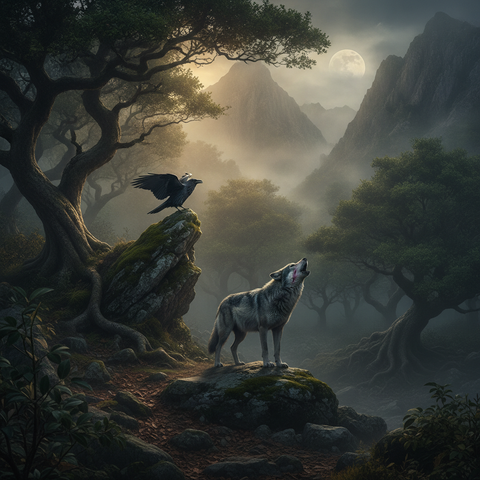
The poem is called Haraldskvæði. It is also known as Hrafnsmál, the lay of the raven, because it takes the form of a dialogue between a valkyrie and a raven talking about the king. Here is the raven's answer, in R. I. Page's translation:
I want to know, you who taste blood, what becomes of the berserkir, those fearless heroes, the ones who go wading into battle. They are called the ones clad in wolf skins. In combat they carry bloody shields. Red with blood are their spears when they come to fight. They form a closed company. The prince, in his wisdom, places his trust in such men, who split the enemy's shields.
Two details not to miss. The "blood-tasters" the poem addresses are a kenning, a poetic metaphor, standing for the ravens come to feed on the dead. And the úlfheðnar are no isolated turn of phrase: they come back in Vatnsdæla saga and in Grettis saga, and the texts consistently present them as the elite retinue of the first king of Norway. They wore the wolf skin over their mail.
What the objects confirm
Archaeology backs the picture up, over a span that reaches far beyond the Viking Age:
- The Torslunda plate, on the island of Öland, found in the spring of 1870: a wolf-headed warrior armed with sword and spear, beside a one-eyed dancer wearing a bird-headed helmet whom specialists read as Odin.
- The Gutenstein scabbard, found in 1887 near Sigmaringen in the grave of a seventh-century Alemann: a wolf-headed warrior, sword and spear in hand.
- Scene 36 of Trajan's Column, completed in 113: Germanic warriors in bear hoods and wolf hoods standing together. It is, along with Hafrsfjord, the only known evidence of bear-warriors and wolf-warriors fighting side by side.
Snorri describes these men in his turn in Ynglinga saga: Odin's men went without armour, mad as dogs or wolves, bit their shields, and neither fire nor iron could touch them.
The wolf and the raven, always together
Here you meet the founding pair of the Norse imagination of battle. Odin is flanked by two wolves, Geri and Freki, and by two ravens, Huginn and Muninn. Wolf and raven travel together, in poetry as on the bronze plates. That is the symbolic charge carried today by wolf pendants, and you can dig into the mythological side in our article on Fenrir, the wolf who devours Odin at Ragnarök.
How each Harald dies: Kattegat, Stamford Bridge, Jomsborg
The four Viking kings named Harald each die in a different way, and that is exactly why the answers found online contradict one another. Here are the four, one at a time.
The Harald of the series Vikings dies in season 6, episode 19, the second to last of the series. That is the death behind most searches along the lines of Vikings Harald death or Harald Vikings death episode. It is the only one of the four deaths that comes purely from a writing choice.
Harald I Fairhair died around 932 in Rogaland. Snorri claims he was buried under a mound at Haugesund, but his grave has never been found. The monument standing there today dates from 1872: it is a memorial, not a tomb. His death opened a violent succession crisis, since he had wanted to pass supreme power to his favourite son, Eric, against the inheritance law of the day, which called for an equal share. The fratricide that followed earned Eric his nickname, Bloodaxe.
Harald Sigurdsson, called Hardrada, fell on 25 September 1066 at Stamford Bridge, in Yorkshire, facing the army of Harold Godwinson. His invasion had begun well enough. His death is conventionally taken as the full stop of the Viking Age, a few weeks before William landed in England in his turn.
Harald Bluetooth died at Jomsborg on 1 November 985, after being driven from power. His end is told by very late texts, and must be handled with the same care as the rest of his legend.
Harald Hardrada, the last Viking king, and the lineage that never existed
Harald Sigurdsson is played by Leo Suter in Vikings: Valhalla, and his real career is even more of a novel than the character's. Born in Ringerike in 1015 or 1016, he was the third son of Åsta Gudbrandsdatter by her second husband, Sigurd Syr.
Fifteen years of exile, from Kiev to Constantinople
His path through exile is one of the best documented of the period:
- 29 July 1030, Stiklestad. At fifteen, Harald gathered six hundred men to join his half-brother on his mother's side, Olaf Haraldsson. The battle was lost, Olaf died, Harald was badly wounded.
- 1031, Kievan Rus'. Taken in by Yaroslav the Wise, whose wife was a distant relative, he was made captain of his troops and fought the Poles.
- Around 1033-1034, Constantinople. He joined the Varangian Guard, the Scandinavian corps in the service of the Byzantine emperor, and rose to command it.
- 1046, the return. He allied with the Dane Sweyn Estridsen against Magnus the Good, who agreed to share power. Magnus died the following year: Harald reigned alone.
His nickname, harðráði, literally means "hard in counsel". It is usually rendered as the Ruthless or the Stern. The more flattering epithets, the Lightning of the North or the last of the Vikings, were pinned on him long after his death.
A genealogy that does not hold
There remains the point nobody makes. The series, like the sagas, makes him a descendant of Harald Fairhair. Yet most historians treat that lineage as a later fabrication. The argument is hard to answer: this prestigious ancestry is never invoked in his lifetime, when it would have weighed heavily in his claim to the Norwegian throne. It appears when the sagas are put into writing, two centuries later, in a political context that needed straight genealogies.
Harald Bluetooth: the Viking king in your phone
The fourth Harald is Danish, he christianised his kingdom, and his name sits today in every device you connect without wires. He is the Harald always treated apart, never linked to the other three.
Harald Gormsson, son of Gorm the Old and Thyra, became king of Denmark around 958. He imposed Christianity after the ordeal of the red-hot iron, endured without harm by a certain Poppo, an episode Adam of Bremen places in 966. Around 960 he had the great Jelling stone carved, recalling his parents, his conquest of Denmark and Norway, and the conversion of the Danes. The Jelling stones have been on the UNESCO World Heritage list since 1994.
His nickname raises an amusing problem: blátǫnn appears only in the Chronicon Roskildense, in the thirteenth century, almost three hundred years after his death. And in Old Norse, blár means "dark" just as much as "blue". The theories run from a rotten tooth to an excessive fondness for bilberries, by way of the dental practices attested on Gotland, where teeth were filed or dyed.
Why your phone carries his name
Then comes the fact nobody expects in an article about the series. In 1997 the wireless specification Bluetooth was named after him, on a simple analogy: the technology was meant to unite devices as Harald had united the Danish tribes. Better still, the Bluetooth logo is a bind rune of the Younger Futhark superimposing his two initials, Hagall and Bjarkan. If you want to learn to read signs of this kind, our guide to the Viking runic alphabet goes through every character and its meaning.
Wearing Harald's signs: choosing a Norse symbol that stands up
A well-chosen Norse symbol says something verifiable; badly chosen, it gives the wearer away at once. Here is the method, in order.
- Check what the motif actually represents before wearing it. A Norse sign either has a documented meaning or it has none. In between, there is only decoration.
- Prefer an attested sign to a series logo. A Younger Futhark rune lasts a thousand years. An emblem made for an opening credit ages in five seasons.
- Choose the wolf if you want the figure most heavily loaded with this warrior imagination. The texts are clear: it is the animal of the royal guard, not an ornament added later. Wolf jewellery takes up that register without turning it into caricature.
- Match metal to skin tone. Silver and steel support cool complexions, bronze and brass warm up golden ones. A badly matched wolf ring goes flat on the hand.
- Weigh use before effect. Sharp relief catches on sleeves and pockets. For everyday wear, an engraving cut into the metal holds up far better.
- Avoid invented rune compositions. A row of characters lined up at random is spotted at once. If you want text, pick a real word and know what it says.
One last piece of common sense. Norse objects that come out of the ground are almost always plain, repetitive and worn. Spectacular pieces exist, but most of what those men and women wore came down to one simple motif, worn for a long time. That is as true of a wolf hoodie as of a pendant: the right motif beats the crowded one.
FAQ: your questions about Harald
Who plays King Harald in the series Vikings?Two actors play Haralds on screen. The Finnish actor Peter Franzén plays Harald Fairhair from seasons 4 to 6. In Vikings: Valhalla, it is Leo Suter who plays Harald Sigurdsson, an entirely different character inspired by Harald Hardrada.
Who was the wife of Harald the Viking?That depends which Harald. In the series, he marries Astrid after killing Ellisif's husband. The historical king, according to Snorri, had eight wives or concubines, among them Åsa, daughter of the jarl of Lade, Gyda Eiriksdatter, Ragnhild Eiriksdotter of Jutland, mother of Eric Bloodaxe, and Snæfríðr, daughter of a Sami chieftain. These unions were political tools first: each one locked down a region.
Did Harald really swear not to cut his hair?It is Snorri Sturluson who reports the vow, three centuries after the events, crediting it to advice from Gyda. No contemporary text confirms it, and recent scholarship reads it as a legend built after the fact to explain a skaldic nickname.
How many children did Harald Fairhair have?Snorri credits him with twenty-three children, twelve of whom became kings and two kings of all Norway. Modern historians take that teeming offspring to be partly a reconstruction designed to legitimise later dynasties.
Is Harald responsible for the settlement of Iceland?It was long believed so, on the word of the sagas, which describe Norwegians fleeing his tax tyranny. Archaeology has settled it: the settlement of Iceland begins before his reign. The story of the flight comes from Icelandic tradition, hostile to kingship of any kind from its very origins.
Are the Harald of Vikings and the Harald of Valhalla the same man?No, and this is the most widespread confusion of all. Vikings: Valhalla is set about a hundred years after the parent series. Its Harald is Harald Sigurdsson, the future Hardrada, presented as a distant descendant of the first. Two men, two centuries, two separate stories.