
Judith in Vikings: the Princess, the Queen and the Poem
of reading - words
Three different women hide behind the search term judith viking, and almost nobody bothers to tell them apart. There is the Northumbrian princess from the series Vikings, the one whose ear is cut off in front of the court. There is a Queen of Wessex who genuinely existed in the ninth century. And there is the heroine of a poem, copied into the most famous manuscript in Anglo-Saxon literature.
The pages that cover the subject pick one of them, usually the first, and leave the other two aside. You come away with an episode recap, none the wiser about what the show invented or what history actually says.
This guide separates the three Judiths that the search term runs together. You will find the character's full arc and the dated chronology of the queen who inspired her. You will also find a mistake in the series that nobody ever points out, and the unexpected link between this name and the wolf of the Norse battlefield.
Key takeaways
- Judith is a recurring character from seasons 2 to 5, played first by Sarah Greene and then by Jennie Jacques.
- She is the daughter of King Aelle of Northumbria and the wife of Aethelwulf, son of King Ecbert of Wessex.
- She dies of cancer in season 5, after poisoning her own son Aethelred.
- A real Queen Judith did exist: Judith of Flanders, daughter of Charles the Bald, crowned Queen of Wessex in 856 at roughly 12 years old.
- The series gets one major point wrong: the real Judith was Alfred the Great's stepmother, not his mother.
Who is Judith in the series Vikings
Judith is the Northumbrian princess who becomes Queen of Wessex, daughter of King Aelle and wife of Prince Aethelwulf. So the answer to the most common doubt is yes: she really is the daughter of Aelle, the Northumbrian king that Ragnar Lothbrok pursues with such stubborn vengeance, and of Queen Ealhswith.
Her entry into the story fits into a single clause of a treaty. Aelle and Ecbert, King of Wessex, are looking for an alliance against the Norse raids, and that alliance is sealed by a marriage: Judith to Aethelwulf, Ecbert's son. She appears for the first time in season 2, episode 7, titled Blood Eagle.
Nothing in that starting point hints at what she will become. The series presents her as a pious, educated and curious young woman, a world away from the shieldmaidens of Kattegat. That curiosity is precisely what will ruin her, and then save her. This world of Norse and Anglo-Saxon courts, built on dark metal and worn symbols, runs through a good part of our wolf jewellery.
Who plays Judith in Vikings
Two actresses take on the role in turn, which explains why some viewers get confused. Sarah Greene plays Judith through season 2, from her first appearance onwards. The role is then taken over by Jennie Jacques, who holds it from season 3 to the end of season 5, some forty episodes in all. It is this second performance, the longer one, that audiences associate with the character.
Judith's journey, from Northumbrian princess to Queen of Wessex
Judith's arc comes down to four turning points, and each one leaves her a little less obedient than the last. The series does not tell the story of a planned rise but of a series of forced doors.
- The bride of alliance: married to Aethelwulf to bind Northumbria and Wessex together, she gives birth to a first son, Aethelred, a year after the wedding.
- The intellectual awakening: her fascination with the monk Athelstan, who has lived among the Norsemen and believes in both God and Odin, opens a crack in her closed world. King Ecbert, for his part, encourages her political education.
- The mother of two heirs: her affair with Athelstan produces a second son, christened Alfred, the show's future Alfred the Great.
- The woman of power: in the later seasons Judith no longer endures the court, she works it, right up to decisions nobody around her dares to take.
That shift from piety to political calculation is the character's real subject. The series never quite passes judgement on it, and that is what makes Judith so hard to file away.
Why Judith's ear is cut off in the series
Judith's ear is cut off as public punishment for her adultery, after Alfred is born. The scene is one of the harshest in the series, and one of the most searched for.
Here is how it unfolds. Returning from campaign, Aethelwulf discovers that his wife is pregnant by another man. Judith refuses to name the father. Found guilty of adultery, she is sentenced to have her nose and ears cut off, a shaming punishment designed to mark her for life. The ordeal begins with one ear. Unable to bear it, she finally speaks the name of Athelstan.
That name is what saves her. King Ecbert, who considers Athelstan a holy man, declares the child a gift from God and halts the sentence. Judith keeps her scar, but she also gains a stronger position at court.
On the substance, the series is not entirely off the mark: Anglo-Saxon law codes did provide for shaming corporal punishments against women found guilty of adultery. The staging, though, belongs entirely to the writers.
When and how does Judith die in Vikings
Judith dies of cancer in season 5, shortly after poisoning her own son Aethelred. That is the answer to the most asked question about the character, and it comes down to two acts.
The first is a murder. Convinced that Aethelred will never stop plotting against his half-brother Alfred, who is ill and unsteady on the throne, Judith pours poison into his cup during a dinner. She holds him in her arms as he dies. She then claims the act openly in front of Alfred, in episode 17, The Most Terrible Thing, with a chilling argument: you do not keep power without doing terrible things.
The second is a confession. Judith tells Lagertha that she has a lump in her breast and that she is dying. She passes away in her bed in episode 19, What Happens in the Cave, surrounded by Alfred, Lagertha and Elsewith. The series grants her a calm death, which, given her arc, reads like a statement of intent from the writers.
Why Judith divides viewers so sharply
Judith is one of the most argued-over characters in the series, and both camps have solid arguments. Fan forums devote as many hostile threads to her as they do defences.
What she is most often accused of:
- Constant opportunism, switching allegiance the moment the wind changes.
- An outright betrayal of Athelstan, and then of Aethelwulf.
- Poisoning her own son, which many consider unforgivable whatever the motive.
What her defenders see:
- A woman with no legal power at all in an entirely male court, left with nothing but influence.
- A character who pays the real price of power, where the men of the series kill without anyone batting an eye.
- A trajectory that holds together from start to finish, from the mutilated young woman to the queen who decides alone.
It is yours to settle. The series carefully avoids doing it for you.
Judith of Flanders, the very real queen behind the character
Yes, a Queen Judith really did exist, but she was not Anglo-Saxon: she was Frankish. Her name is Judith of Flanders, and her life is more novelistic than the character's.
Here is her chronology, as the sources give it:
- Born around 843, daughter of Charles the Bald, King of West Francia, and great-granddaughter of Charlemagne.
- Married to Aethelwulf, King of Wessex, on 1 October 856, at the royal palace of Verberie-sur-Oise. She is around 12 years old at the time.
- The ceremony is led by Hincmar, Archbishop of Reims, who places a diadem on her head. Aethelwulf grants her the title of queen, even though Wessex custom forbade the king's wife from bearing that title or sitting on the throne. It is a major institutional anomaly for the period.
- Widowed on 13 January 858, she marries Aethelbald, her late husband's own son, and therefore her stepson.
- Widowed again on 20 December 860, with no children from either marriage.
- Brought back to Francia and placed in the monastery at Senlis, she leaves in the spring of 862 with Baldwin Iron Arm. Their marriage is regularised in 863 after the pope steps in, and Baldwin receives Flanders.
Two royal marriages before the age of twenty, an elopement, and at the end of it the founding of a comital dynasty. The character on screen looks almost tame by comparison.
What the series invented and what it kept
The series keeps the skeleton and rebuilds the flesh entirely. The table below separates, for the on-screen Judith, what comes from the sources and what comes from the writers.
| Element | In the series | In history | Verdict |
|---|---|---|---|
| Judith's origins | Northumbrian princess, daughter of King Aelle | Frankish princess, daughter of Charles the Bald | Invented |
| Mother of Alfred the Great | Yes, from her affair with Athelstan | No, Alfred was born in 849 to Aethelwulf and Osburh | Invented |
| Title of queen | Queen of Wessex | Crowned queen in 856, against local custom | Faithful |
| Marriage to her husband's son | Absent | Marries Aethelbald, son of Aethelwulf, in 858 | Dropped |
| The ear punishment | Public mutilation for adultery | Corporal punishments attested in Anglo-Saxon law | Plausible |
| Final fate | Dies of cancer in season 5 | Flees to Francia, marries Baldwin, founds Flanders | Invented |
One point deserves highlighting, because no mainstream page mentions it. Alfred the Great was born in 849, to Aethelwulf and his first wife Osburh. The historical Judith, born around 843, only married Aethelwulf in 856. She was therefore Alfred's stepmother, with barely six years between them. Making her his mother is chronologically impossible.
Judith, the wolf and the Beowulf manuscript
There is a third Judith, and she is the one who links this name to the wolf. An Old English poem titled Judith has come down to us, and where it was preserved is enough to show its importance.
The poem is copied into the Nowell Codex, the manuscript that contains Beowulf. Judith follows the great heroic poem immediately, in the same scribal hand, in a copy dated to around 975 to 1025. The text is incomplete: the manuscript suffered in the Cotton library fire of 1731, and part of the poem is lost.
What survives contains a battle scene, and that scene summons a central figure of Anglo-Saxon poetry: the beasts of battle. Three animals announce the slaughter and follow it to feed. The wolf, the raven and the eagle. In Judith they appear at lines 204 to 212, then again at lines 292 to 296. The lean wolf rejoices in the wood before the blood is spilled.
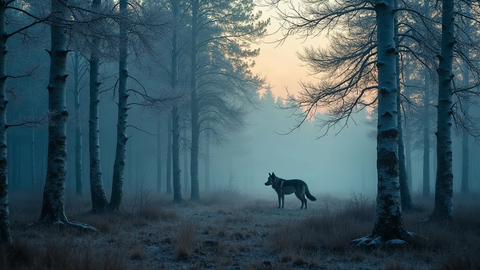
This is no isolated coincidence. The same trio haunts eight other Old English poems, among them Beowulf and The Battle of Maldon. And it echoes, on the other side of the North Sea, the wolves of Norse mythology. There you find Geri and Freki, Odin's two companions who eat at his table, and Fenrir, the chained wolf whose jaws will open at Ragnarok. In these texts the wolf is never mere scenery. He is the witness who knows, before men do, that the battle will happen. That presence is what you find in our wolf pendants and in our wolf decor.
Wearing the Norse imagination day to day
The look of the series rests on three things: material, restraint and symbol. Here is how to carry it over without slipping into fancy dress.
- Choose dark or aged metals rather than shiny ones: patinated brass and blackened steel carry this vocabulary far better than polished gold.
- Favour one strong piece over a stack of accessories. A bold wolf ring is enough to set the tone.
- Avoid chatty prints. An animal motif works when it stays graphic, as on our wolf t-shirts.
- Check that your tones agree: this register lives in greys, browns, deep greens and black, never in bright colours.
- Keep a symbol that means something to you rather than a decorative one. A wolf, a raven, a rune: the meaning matters more than the number.
FAQ about Judith, the series and the history
The five most asked questions about Judith concern her identity, her death, whether she really existed, her descent from King Aelle and her place among the other characters. Here are the short answers.
Who is Judith in Vikings
Judith is the Northumbrian princess, daughter of King Aelle and Queen Ealhswith, married to Prince Aethelwulf of Wessex to seal an alliance between the two kingdoms. She appears in season 2 and becomes Queen of Wessex. She is the mother of Aethelred and of Alfred, the show's future Alfred the Great.
Does Judith die in Vikings
Yes. Judith dies in season 5, of cancer, after telling Lagertha that she has a lump in her breast. She passes away in her bed, surrounded by Alfred, Lagertha and Elsewith. Her death comes shortly after the poisoning of her son Aethelred, which she claims openly in front of Alfred.
Who was the real Queen Judith
The historical Queen Judith is Judith of Flanders, born around 843, daughter of Charles the Bald. She married Aethelwulf, King of Wessex, on 1 October 856 at Verberie, and received the title of queen against local custom. Widowed twice, she then married Baldwin Iron Arm and founded the line of the Counts of Flanders.
Is Judith the daughter of Aelle
Yes, in the series. Judith is presented as the daughter of King Aelle of Northumbria, Ragnar Lothbrok's relentless enemy, and of Queen Ealhswith. That parentage is an invention of the writers: the historical Judith was the daughter of the Frankish king Charles the Bald, with no connection to Northumbria at all.
Who is Ivar's wife in Vikings
Ivar the Boneless's wife in the series is Freydis, whom he marries in Kattegat and raises to the rank of queen. She has no connection to Judith, who belongs to the Anglo-Saxon side of the story and never crosses paths with Ivar in a shared plotline.