
Ouroboros: meaning of the snake eating its own tail
of reading - words
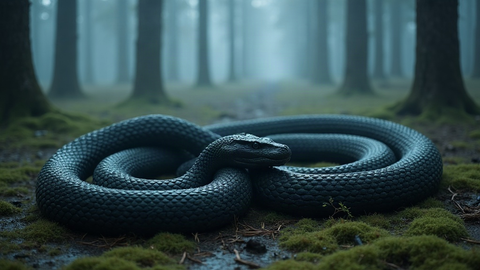
A serpent coiled into a circle, its tail caught between its own fangs. The ouroboros is one of the rare symbols you meet in ancient Egypt, in Greek alchemical manuscripts, in the myths of the Far North and on the skin of someone you passed in the street yesterday. Over three thousand three hundred years of circulation, and still the same image.
You are probably looking for what it means before wearing it, giving it or having it inked. Here is what the sources actually say, and what the Norse world made of it through Jörmungand, the serpent that girdles the world and brother of the wolf Fenrir.
Key takeaways
- The ouroboros shows a serpent or a dragon biting its own tail: it stands for the endless cycle, the unity of opposites and the death that feeds life.
- Its name comes from the Greek oura (tail) and boros (devouring).
- The oldest clearly dated depiction is found in the tomb of Tutankhamun, in the 14th century BCE.
- In the Norse world, the role belongs to Jörmungand, the Midgard serpent, brother of the wolf Fenrir and of Hel.
- In alchemy, it carries the Greek inscription hen to pan, "the One is the All".
Ouroboros: what does the snake eating its own tail mean?
The ouroboros is a serpent, sometimes a dragon, drawn as a closed circle and busy devouring its own tail: it pictures a cycle with neither beginning nor end. The name comes from ancient Greek, from oura, the tail, and boros, devouring. Literally: "the one that eats its tail".
The power of the motif lies in its double reading. The serpent destroys and feeds itself in the same gesture. It dies by its own mouth and lives on its own flesh. Three core meanings follow, and every culture that adopted the symbol keeps at least one of them:
- The eternal cycle: time does not run from point A to point B, it turns. Seasons, generations, worlds.
- The unity of opposites: life and death, creation and destruction, spirit and matter are not two camps but two faces of one body.
- Renewal through the ending: nothing is lost, everything is transformed. Something has to close for what follows to exist.
The creature changes with the period. A serpent most of the time, a dragon in medieval European traditions, sometimes two intertwined beasts forming a double ring. The meaning barely moves.
Jörmungand, the ouroboros of Norse mythology
In the Norse world the ouroboros has a name: Jörmungand, the Midgard serpent, so vast that he encircles the whole earth and closes his jaws on his own tail. His Old Norse name is Miðgarðsormr, literally the worm of Midgard.
Snorri Sturluson tells the episode in the Gylfaginning. Odin seizes the serpent, still young, and throws him into the deep sea. The plan backfires: far from vanishing, the creature grows in the waters until he rings the world of men and bites into himself. The very act meant to remove the threat gives him his final shape.
Two scenes give the myth its flesh:
- Thor's fishing trip (Hymiskviða): Thor sets out with the giant Hymir, baits a line with an ox head and hooks the serpent. He hauls him aboard and raises Mjöllnir. Hymir, terrified, cuts the line.
- Útgarða-Loki's cat (Gylfaginning): challenged to lift a plain cat, Thor manages to raise a single paw. He is told afterwards that the animal was Jörmungand in disguise, and that the feat left the assembled giants cold with fear.
One point deserves to be said plainly, because almost nobody spells it out: the word "ouroboros" never appears in the Norse sources. It is a Greek term, coined around the Mediterranean and applied after the fact by modern commentators. The Eddas speak of the Midgard serpent. Jörmungand is an ouroboros by shape and by function, not by the vocabulary of those who wrote him down. The nuance matters if you want to wear the symbol knowing what it holds.
Fenrir and Jörmungand: the wolf and the serpent, two jaws of one cycle
Jörmungand is no isolated monster: he is the brother of the wolf Fenrir, and that kinship explains why Norse cosmology is itself an ouroboros. Loki and the giantess Angrboda father three children: Fenrir the wolf, Jörmungand the serpent, and Hel who rules over the dead. Three creatures pushed aside by the gods, three creatures that will come back.
Ragnarök closes the circle. The serpent leaves the sea and poisons the sky. Thor strikes him down, then collapses after nine steps, killed by the venom, as the Völuspá says at stanza 56. Fenrir breaks his bonds and devours Odin before falling to the hand of Odin's son Víðar. Loki's two children kill the two greatest gods, and die with them.
Then the earth rises again from the waves. Survivors repopulate the world. A new generation of gods settles in. The Norse ending is not an ending, it is a mouth closing on a tail. The wolf and the serpent are its two jaws: one encircles the world, the other devours the one who rules it.
This is where the symbol stops being a Mediterranean curiosity and becomes a key to reading the North. If the subject speaks to you, our article on the wolf Fenrir details the fate of the brother wolf and his place in Ragnarök.
From Egyptian tombs to Greek alchemy: the real origins
The oldest clearly dated depiction of the ouroboros is found in Egypt, in the tomb of Tutankhamun (KV62), in the 14th century BCE. It appears in a funerary text known as the Enigmatic Book of the Netherworld: two circular serpents there surround a figure uniting Ra and Osiris, one enclosing the head and upper body, the other the feet.
What follows fits into a few steps:
- 16th to 14th century BCE: the motif appears in Egyptian funerary iconography. Some sources trace the earliest forms back to the 16th century, and the dating remains debated.
- Hellenistic period: the motif passes into the Greco-Roman sphere, where it receives its Greek name and its philosophical charge.
- Around 300 CE: Zosimos of Panopolis, the first great Greco-Egyptian alchemist, states the principle that accompanies the drawing: "One is the All, and through it the All".
- Middle Ages and Renaissance: Latin alchemical treatises take up the figure again, often as a dragon, and turn it into the emblem of the great work.
A useful clarification: Egypt produced the image, Greece produced the word. Crediting the Greeks with inventing the symbol is a common mistake that the manuscripts contradict.
The ouroboros culture by culture
The same circle has been reread by at least eight traditions, and while the creature changes, the message always turns around cycle and totality. Some of these traditions literally depict a serpent biting its tail, others offer a parallel of shape and meaning that comparatists have set alongside the ouroboros. Here is the summary.
| Culture | Name or form | Period | What the symbol says |
|---|---|---|---|
| Ancient Egypt | Enigmatic Book of the Netherworld, tomb KV62 | 14th century BCE | Protection of the solar body, circular time, daily rebirth |
| Greece and Alexandrian alchemy | Chrysopoeia of Cleopatra | 3rd century, copied in the 10th-11th | The One is the All, unity of matter |
| Norse world | Jörmungand, the Midgard serpent | Eddic texts, 13th century | Edge of the inhabited world, an end that prepares the new beginning |
| Gnosticism | Treatises and amulets | 2nd to 4th century | Boundary between the material world and knowledge |
| Medieval and Renaissance alchemy | Dragon biting its tail | 12th to 17th century | The great work, matter that transforms without being lost |
| Mesoamerica | Quetzalcóatl, the coiled feathered serpent | Classic and Postclassic periods | Calendar cycles, alternating destruction and creation |
| West Africa | Aido Hwedo, the rainbow serpent | Fon oral tradition | Support of the world, continuity of creation |
| China | Kinship of shape with yin and yang | Antiquity | Interdependence of opposites, perpetual movement |
What varies from one column to the next: the animal, the name, the degree of divinity granted to it. What never varies: the idea that a closed system regenerates from within. None of these traditions makes the circular serpent a symbol of bare death. Everywhere, the ending is a hinge.
Ouroboros, alchemy and initiatory societies
The most famous image of the alchemical ouroboros fits on a single page: the one in the Chrysopoeia of Cleopatra, kept in Venice in the Codex Marcianus graecus 299. The manuscript is a 10th and 11th century copy of a far older Alexandrian text. It shows a serpent with half its body black and the other half pale, its tail in its mouth. Three Greek words are written inside the circle: hen to pan, "the One is the All".
That formula sums up the alchemical thesis: matter is one, it changes state without ever leaving the circle. Zosimos of Panopolis writes it around 300 CE, and Latin treatises will repeat it for a thousand years.
And in Freemasonry? The question comes up often, so let us answer it head on. The circle and the serpent do appear in masonic imagery, where they serve as an emblem of eternity and of the unbroken chain between members. It is a late borrowing of an ancient symbol, in the same way the square and compasses were borrowed from the building trades. There is no secret signature there and no mark of exclusive belonging: the ouroboros was circulating in European engravings long before speculative lodges appeared, and it still circulates today far away from them.
The most surprising episode is more recent, and it is scientific. During the winter of 1861-1862, the chemist August Kekulé dozed off in front of his fireplace and saw a serpent seize its own tail. In 1865, he published the ring structure of benzene, one of the founding results of organic chemistry. He only told the story publicly in 1890, at the Benzolfest in Berlin, twenty-five years later. So the old Egyptian serpent helped, by metaphor at least, to describe a molecule.
Ouroboros tattoo: meaning, styles and placements
The ouroboros tattoo is almost always worn as the mark of a cycle lived through: a stage closed, a rebirth claimed. That is what explains its popularity among people coming out of something.
The meanings claimed most often:
- Coming out of an addiction: the circle recalls the loop, and the fact of having taken its measure.
- A grief lived through: death feeding life, without denying the loss.
- A deliberate fresh start: a change of life, of trade, of country.
- A loyalty to the long view: the conviction that nothing is final, neither failures nor successes.
The styles that work best on a circular motif:
- Fine line: thin, even stroke, graphic result, ideal in small format.
- Blackwork: solid black fills, marked scales, strong presence.
- Dotwork: shading by dots, very readable on curves.
- Norse ornamental: the serpent treated as interlace, in the spirit of Scandinavian zoomorphic patterns.
The technical point every tattoo artist repeats: a perfect circle needs a flat area or a clean coil. The forearm, the calf, the shoulder blade and the wrist give the best results. On a joint or on a surface that curves too much, the circle warps as soon as the body moves.
If you are still hesitating on the design, our guide to the Viking wolf tattoo explores the Norse alternatives, Fenrir first among them. And to test a drawing before going under the needle, the wolf tattoos collection lets you live with the motif for several days.
Wearing the ouroboros every day: choosing the right piece
A symbol of cycle worn every day first has to survive every day: the choice comes down to the metal, the diameter and the finish of the joining point. Here is the checklist to run through before buying.
- Check the joining point between head and tail. That is where a cheap piece gives itself away: visible solder, misalignment, scales that stop short. Look at it in a macro photo before you order.
- Choose the metal according to how often you will wear it. Stainless steel takes showers and sport without flinching. Sterling 925 silver is finer and more noble, but asks for a polishing cloth now and then.
- Measure before ordering a ring. An ouroboros band is wide: take half a size above your usual one, otherwise it jams at the second knuckle.
- Look at which way the serpent reads. Some pieces coil the head inwards, others outwards. Worn, the first reads for you, the second for everyone else.
- Consider the double ring if you want a more graphic result: two intertwined serpents hold the eye better than a plain circle on a long chain.
- Match the size to the rest. A 3 cm pendant dominates a plain outfit; below 2 cm it becomes a detail people discover.
At Terre des Loups, let us be honest: the Norse equivalent of the endless circle is worn more often under the features of the wolf than those of the serpent. It is the same idea of cycle, carried by Fenrir rather than by his brother. You will find that spirit in the heavy wolf rings and in the wolf pendants and necklaces worked in interlace. The wolf bracelets with facing heads pick up the same closed loop, and the full wolf jewellery range plays the motif across every format. For a wall rather than a wrist, the wolf wall art carries the same symbolism of circle and pack.
Ouroboros FAQ
Here are the short answers to the questions most often asked about the snake eating its own tail.
What does the ouroboros mean?It stands for the eternal cycle: the end that meets the beginning, the destruction that feeds creation, the unity of opposites. Depending on the tradition, it also carries the idea of eternity, totality and rebirth.
Is the ouroboros a Norse or an Egyptian symbol?Both, but not in the same way. The image is born in Egypt, in funerary iconography by the 14th century BCE at the latest. The name is Greek. The Norse world has its own creature of identical shape, Jörmungand, without ever using the word ouroboros.
What does the ouroboros mean in Freemasonry?The serpent circle there stands for eternity and for the continuity of the chain of union between members. It is a borrowing from an ancient symbol already widely spread in European engravings, not a sign of recognition specific to the lodges.
What does an ouroboros tattoo mean?Most often: a stage closed. Coming out of an addiction, a grief lived through, a change of life owned. The wearer chooses the circle because they have measured a loop and decided to name it.
What is the link between the ouroboros and Loki?Jörmungand, the Norse circular serpent, is the son of Loki and the giantess Angrboda. His siblings are the wolf Fenrir and Hel, ruler of the dead. So Loki is not the ouroboros, he is its father.