
The wolf's dwelling: territory, den and pack
of reading - words
The habitation of the wolf is one of the most fascinating questions posed by the study of this animal. Unlike many predators, the gray wolf (Canis lupus) is not confined to a single type of environment: it occupies temperate forests, arid steppes, icy tundras and mountain ranges with equal efficiency. This exceptional ecological plasticity makes it one of the terrestrial mammals with the largest global distribution area. In France, after decades of absence, the wolf has gradually reconquered the Alps, the Massif Central and other regions, reaching, according to the French Biodiversity Office (OFB), around 1,104 individuals recorded during the winter of 2023-2024. Understanding where and how the wolf lives also means better understanding the challenges of its cohabitation with human activities.
The essential things to remember
- The gray wolf inhabits a wide variety of biotopes: forests, steppes, mountains, arctic tundras.
- The den is used mainly in spring and summer to raise cubs; the rest of the year, the pack moves within its territory.
- A pack territory varies between 200 and 1,500 km² depending on the density of available prey.
- The wolf can travel up to 60 km in a single day to monitor and defend its living space.
- In France, around 1,104 wolves are estimated in 2024, spread over 125 areas of permanent presence.
From forests to tundras: gray wolf biotopes
The gray wolf, a species with remarkable plasticity
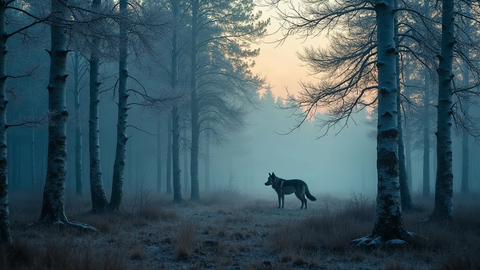
Canis lupus is one of the rare large predators capable of surviving in climatic and ecological conditions as contrasting as the boreal forests of Siberia, the deserts of Arabia, the North American plains or the steep reliefs of the Balkans. This capacity for adaptation, often referred to as ecological plasticity, is based on several biological characteristics: opportunistic feeding, a cooperative social system (the pack), and an ability to move over very long distances.
Historically, the wolf occupied the entire northern hemisphere, from the Arctic to Mexico in America, and from Western Europe to the coasts of the Asian Pacific. Today, its global distribution remains extensive but fragmented: it is found in North America (Canada, Alaska, northern states of the United States), in Europe (Scandinavia, Poland, Balkans, Iberian Peninsula, Italy, France), and in Asia (Russia, China, Central India, Middle East).
The four major biomes where the wolf is present are:
- Temperate and boreal forests: preferred environment in eastern Europe and Canada, where the density of prey (deer, wild boar) is high.
- Steppes and open grasslands: favored in Central Asia and certain regions of Eastern Europe, with herds of gazelles or antelopes as the main prey.
- Mountain ranges: Alps, Carpathians, Apennines, Rockies. The terrain provides cover and travel corridors.
- The Arctic tundra: reserved for the Arctic wolf (Canis lupus arctos), a subspecies adapted to the Far North with a thick white coat and wide paws for moving on the snow.
Grey wolf, arctic wolf, red wolf, golden wolf: what are the differences in habitat?
Under the name "wolf" is actually a diversity of species and subspecies that occupy different ecological niches. Here is a comparison table to see more clearly:
| Species / subspecies | Scientific name | Main biotope | Geographic distribution | IUCN Status |
|---|---|---|---|---|
| Common gray wolf | Canis lupus | Forests, mountains, steppes | Europe, Asia, North America | Minor concern |
| Arctic Wolf | Canis lupus arctos | Arctic tundra, polar islands | Great Canadian North, Greenland | Minor concern |
| Red Wolf | Canis rufus | Wetlands, coastal forests | Southeastern United States (reintroduced) | Critically endangered |
| African golden wolf | Canis lupaster | Savannahs, semi-arid, agricultural areas | North Africa, Sub-Saharan Africa | Minor concern |
The red wolf is one of the most endangered species in the world: today only a few hundred individuals remain in the swamps and forests of North Carolina, after a reintroduction program launched by the American authorities in the 1980s.
The den and the territory: how the wolf organizes its living space
The den, the heart of the wolf's family life
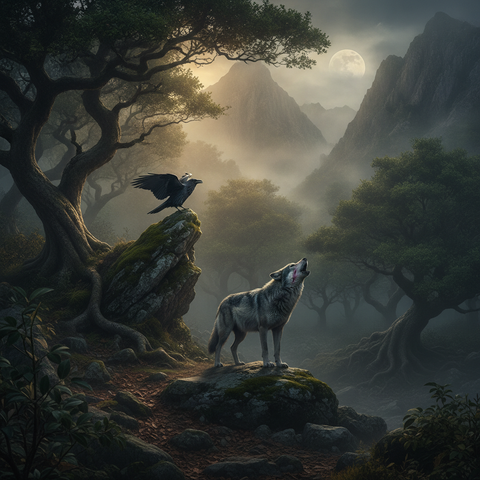
The den is the central space for the reproduction and rearing of cubs. Contrary to the popular image of a deep and dark cave, a wolf's den can take very varied forms: a natural crevice between rocks, a burrow dug into an embankment (sometimes reused from an old foxhole or a badger), a space hidden under the roots of fallen trees, or even a crevice in the rock.
The she-wolf chooses the location carefully, favoring:
- A well-hidden site that is difficult to access for predators.
- Favorable exposure (sunny slope, protection against the prevailing wind).
- Proximity to a water point.
- Easy access to the pack's hunting territory.
The den is occupied mainly in spring and summer, during the first 8 to 10 weeks of the cubs' lives. After this period, the pack begins to move more, and the young wolves are gradually integrated into collective movements. Outside of the breeding season, wolves do not have a fixed home: they sleep where conditions permit, often in open ground or in the shelter of dense vegetation.
A territory defended and marked with precision
The territory of a wolf pack is the living space that it actively defends against other packs and lone wolves. Its surface area varies considerably depending on the availability of prey: between 200 and 500 km² in central Europe where game is abundant, and up to 1,500 km² in regions where prey is rare, such as certain areas of Siberia or North America.
To give a concrete idea of these distances: a territory of 1,500 km² represents approximately twice the area of Paris and its inner suburbs combined. And to keep an eye on it, the gray wolf can travel up to 60 km in a single day during its patrol rounds, an athletic feat that illustrates its remarkable endurance.
Territorial marking is based on several mechanisms:
- Olfactory markings: deposits of urine and feces on high points (rocks, stumps), which contain chemical information on the identity, sex and reproductive state of the animal.
- Soil scratches: scratchings carried out after olfactory deposition to visually and chemically amplify the signal.
- Howls: the collective howl of the pack, audible up to 15 km away in calm weather, constitutes a powerful territorial signal to neighboring packs.
Borders between neighboring territories are generally respected. Wolves that venture into the territory of another pack expose themselves to sometimes deadly confrontations. Buffer zones between territories, unclaimed by any pack, often serve as a corridor for dispersing lone wolves.
The wolf pack: a social structure serving the territory
The pack is the fundamental social unit of the wolf, and it is precisely this collective organization that allows it to effectively manage a large territory and hunt large prey.
In Europe, a pack has on average between 5 and 12 individuals, typically made up of a dominant pair (often called "alpha wolves"), their descendants from previous years and the cubs from the current year. Contrary to popular belief, the hierarchy in a wild pack is not based on aggressive dominance but on family relationships: the dominant pair is simply the breeding pair, and the other members are their children.
The distribution of roles in territorial management is collective:
- The dominant pair drives movements, makes hunting decisions, and is the only one to reproduce in a stable pack.
- Sub-adult wolves (2 to 3 years old) participate in hunts, territorial patrols and contribute to feeding the cubs.
- Cubs (less than one year old) remain at the meeting point (secure area outside the den) while the adults hunt, then are fed by regurgitation.
Every spring, certain young wolves aged 1 to 3 years voluntarily leave the pack to disperse: they can then travel hundreds of kilometers in search of a vacant territory and a partner, sometimes colonizing very distant regions. It is this dispersal mechanism which explains the rapidity with which the wolf recolonized France from Italy.
The wolf in France today: distribution and areas of presence
From Mercantour to the Vosges: how the wolf reconquered France
The return of the wolf to France is one of the stories ofhe most remarkable conservation of European fauna. The wolf had been eradicated from France during the 20th century, the last wild individual having been killed in the 1930s. Its natural reappearance in 1992 in the Mercantour national park (Alpes-Maritimes) constituted a turning point: wolves from Italy, where the population had remained in the Apennines, crossed the border and began to establish themselves on the French side.
Recolonization then took place in successive waves, following natural dispersal corridors:
- The Southern Alps (Mercantour, Queyras, Écrins) were the first areas colonized in the 1990s-2000s.
- The Northern Alps (Belledonne, Chartreuse, Vercors) were reached in the years 2000-2010.
- The Massif Central (Lozère, Cantal, Ardèche) saw the installation of the first packs in the 2010s.
- The Vosges, the Jura, the Pyrenees and the Jura Massif are more recent areas of presence, with individuals still in the exploration or installation phase.
The speed of this recolonization illustrates the exceptional dispersal capabilities of the wolf: a young wolf can travel 1,000 km in a few months to find its own territory.
How many wolves live in France today?
Monitoring the wolf population in France is carried out by the French Biodiversity Office (OFB), in collaboration with State services and networks of local correspondents. The counting method is based on presence indices (prints, feces, photos on camera traps) and genetic analyzes (hair, feces) which make it possible to identify individuals.
According to the OFB report published for winter 2023-2024, the population is estimated at approximately 1,104 wolves, distributed across 125 permanent presence zones identified on the national territory. This figure represents a doubling of the population in less than 10 years (around 530 individuals were estimated in 2018), and reflects both the success of legal protection and the natural reproduction dynamics of the species.
To put this figure into perspective: fewer than 100 wolves were recorded in France in 2000. In 20 years, the population has therefore multiplied by more than 10, making France one of the countries in Western Europe where the dynamic of restoring wolf populations is the strongest.
Cohabitation with livestock farming remains a tense subject. Wolves are responsible for attacks on herds (mainly sheep) every year, which generates conflicts with breeders. The national wolf plan, regularly renewed by the public authorities, regulates the terms of compensation for breeders and authorizes defensive shooting under certain strictly defined conditions.
Threats and protection of wolves: a fragile balance
The wolf benefits from strict protection status in France. It has been classified as a "strictly protected species" since 1979, pursuant to the Berne Convention (Appendix II), and its protection is reinforced by the European Union Habitats Directive (Annex II and IV), which prohibits its capture, trapping and deliberate killing.
Despite this legal framework, several threats weigh on the populations:
- Defense shootings and sampling shootings: in France, the State authorizes each year a quota of wolves that can be legally killed within the framework of the national wolf plan (protection of herds in the event of failure of other preventive measures). This quota, set annually, is a source of controversy between environmental defenders and representatives of the agricultural world.
- Poaching: despite legal protections, wolves are killed illegally every year. The OFB lists identified cases, but the true number is likely underestimated.
- Road collisions: dispersing young wolves travel long distances and cross major roads, which exposes certain individuals to fatal accidents.
- Hybridization with dogs: in some areas, crosses between wolves and domestic dogs have been documented genetically, raising questions about the genetic purity of populations.
Globally, the gray wolf is classified as Least Concern on the IUCN Red List, reflecting the overall stability of the species. But certain regional subpopulations remain very vulnerable, notably in Mexico (Canis lupus baileyi, known as the Mexican wolf) and on the east coast of the United States.
Celebrate your passion for wolves
The wolf has fascinated and inspired for millennia. Whether you are passionate about nature, wildlife lover or simply curious about this emblematic animal, this passion deserves to be extended well beyond reading. At Terre des Loups, you will find a selection of creations dedicated to this exceptional animal: wolf decorations to enhance your interior, wolf figurines for collectors and lovers of detail, and wolf soft toys for young and old. Each piece is designed for true wolf lovers.